
Outdoor & Garden
How to Design a Low-Maintenance Inground Pool Budget Layout
FixingManual guide: Plan a low-maintenance inground pool with a practical budget layout. Fixing Manual compares pool materials, setup costs, decking, equipment, and long-term care.
Image disclosure: Images are AI-generated illustrations, not photographs of FixingManual projects or hands-on product tests.
A pool that looks affordable on a brochure can become expensive once you add decking, drainage, a safety barrier, and equipment. For a low-maintenance inground pool, the layout matters just as much as the shell because placement affects cleaning, filter access, cover use, and how much yard debris reaches the water.
To design a low-maintenance inground pool on a budget, start with a compact, uncomplicated shape, choose a finish you can realistically maintain, and reserve money for the surrounding work. Plan the cover, equipment area, drainage, and safety barrier before choosing decorative upgrades. The goal is a backyard you enjoy using without giving every weekend to upkeep.
1. Set a Complete Low-Maintenance Inground Pool Budget Before Drawing the Pool
Start with the amount you can spend on the finished, usable backyard. A realistic low-maintenance inground pool budget should include more than the shell. A shell price or basic installation package may exclude important site work. Ask the builder to identify exactly what “installed” includes rather than assuming the surrounding yard is covered.
For a broad U.S. starting point, HomeGuide publishes material-specific installation ranges. The following figures are for preliminary planning, and these should not be treated as interchangeable quotes for identical pools because size and scope assumptions differ.
| Pool type | Published installation range | Budget consideration |
|---|---|---|
| Vinyl liner | $25,000–$65,000 | Plan for eventual liner replacement |
| Fiberglass | $45,000–$100,000 | Confirm shell delivery and site-access costs |
| Concrete or gunite | $50,000–$120,000 | Custom features and finishes can expand scope |
Have your proposal separate the pool package from excavation complications, soil disposal, electrical work, permits, drainage, decking, fencing, and landscape repair. Keep a contingency for unknown site conditions. Rock, groundwater, restricted access, and retaining structures need particular attention before you accept a fixed-looking headline price.
2. Match the Size and Shape to How You Will Swim
Write down what the pool needs to do. For a low-maintenance inground pool, choosing only the size you will actually use can also reduce the area that must be cleaned and maintained. Cooling off, water exercise, lap swimming, and hosting a large family lead to different dimensions. A compact recreational pool may suit your household without the installation and ownership costs of a much larger design.
Use a simple rectangle as your first comparison option. Its straight edges can make it easier to organize furniture, paving, and a cover system. Ask the builder to price your preferred curved design against it; a rectangle is not automatically cheaper for every material or site.
Discuss entry steps, usable swimming space, and depth together. A large tanning ledge may look appealing but leave little room to swim in a small shell. If diving is part of your plan, stop treating this as a compact recreational layout and obtain a design specifically suitable for that use.
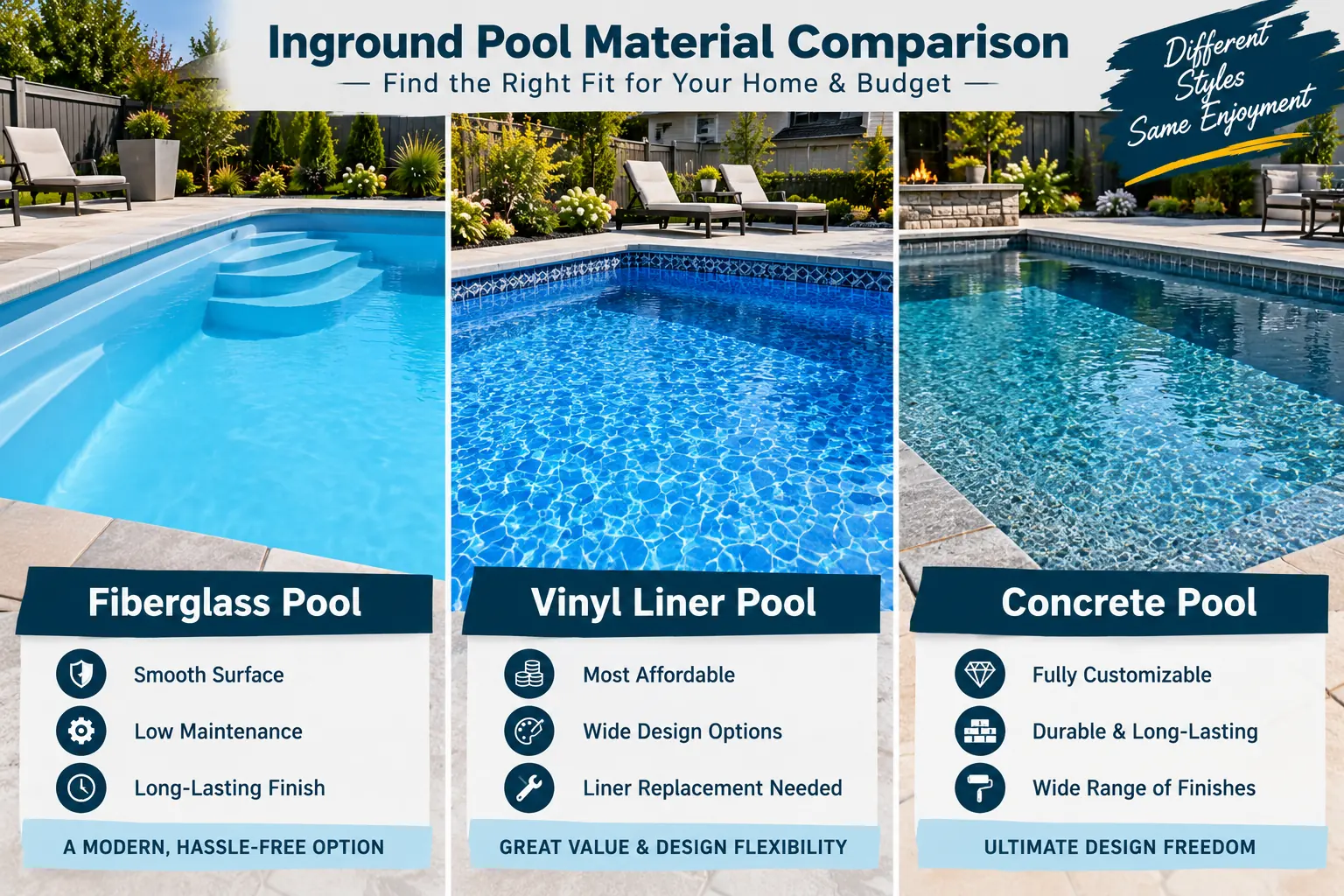
3. Compare Materials for a Low-Maintenance Inground Pool
Fiberglass: a practical low-maintenance option to investigate
Fiberglass deserves a place on a low-maintenance shortlist because its smooth surface can simplify cleaning. HomeGuide describes fiberglass as a relatively low-maintenance option. It still needs water testing, appropriate chemical care, and equipment servicing, and the finish is not immune to staining or damage.
Ask about shell dimensions, warranty exclusions, repair support, and delivery requirements. A shell that fits your wish list may be difficult to bring into a narrow backyard, so confirm access before committing to the model.
Vinyl liner: weigh entry price against future replacement
A vinyl liner pool may offer a lower initial price, but the liner is a future expense. Liner life varies by product, installation, water chemistry, and maintenance. Ask the manufacturer about expected service life and warranty exclusions. Ask a local installer what a replacement for your proposed shape would involve.
Concrete: pay for customization you actually need
Concrete may make sense when a custom footprint solves a real site problem. Its design flexibility comes with finish-care decisions. Ask for written guidance on routine brushing, surface maintenance, and eventual refinishing before choosing an elaborate shape or specialty finish.
4. Place the Pool Where Maintenance Is Convenient
For a low-maintenance inground pool, location should make routine cleaning and equipment access easier. Walk the yard at different times of day before selecting a location. Mark large trees, shade patterns, existing drains, utility routes, and the areas that collect water after rain. Ask your builder to assess how those conditions affect the proposed position.
Avoid placing the water directly beneath overhanging branches where practical. Leave room to reach the pool edges with cleaning tools, remove a robot, and operate the cover. If large trees create access or debris problems, our backyard tree removal cost guide can help you understand that separate project scope.
Keep the equipment accessible. A pump hidden behind dense planting may look tidy on a rendering but be frustrating to service. Show the technician’s walking route, filter-opening clearance, and equipment-removal path on the plan.
5. Sketch a Compact Inground Pool Budget Layout With Room for Everything
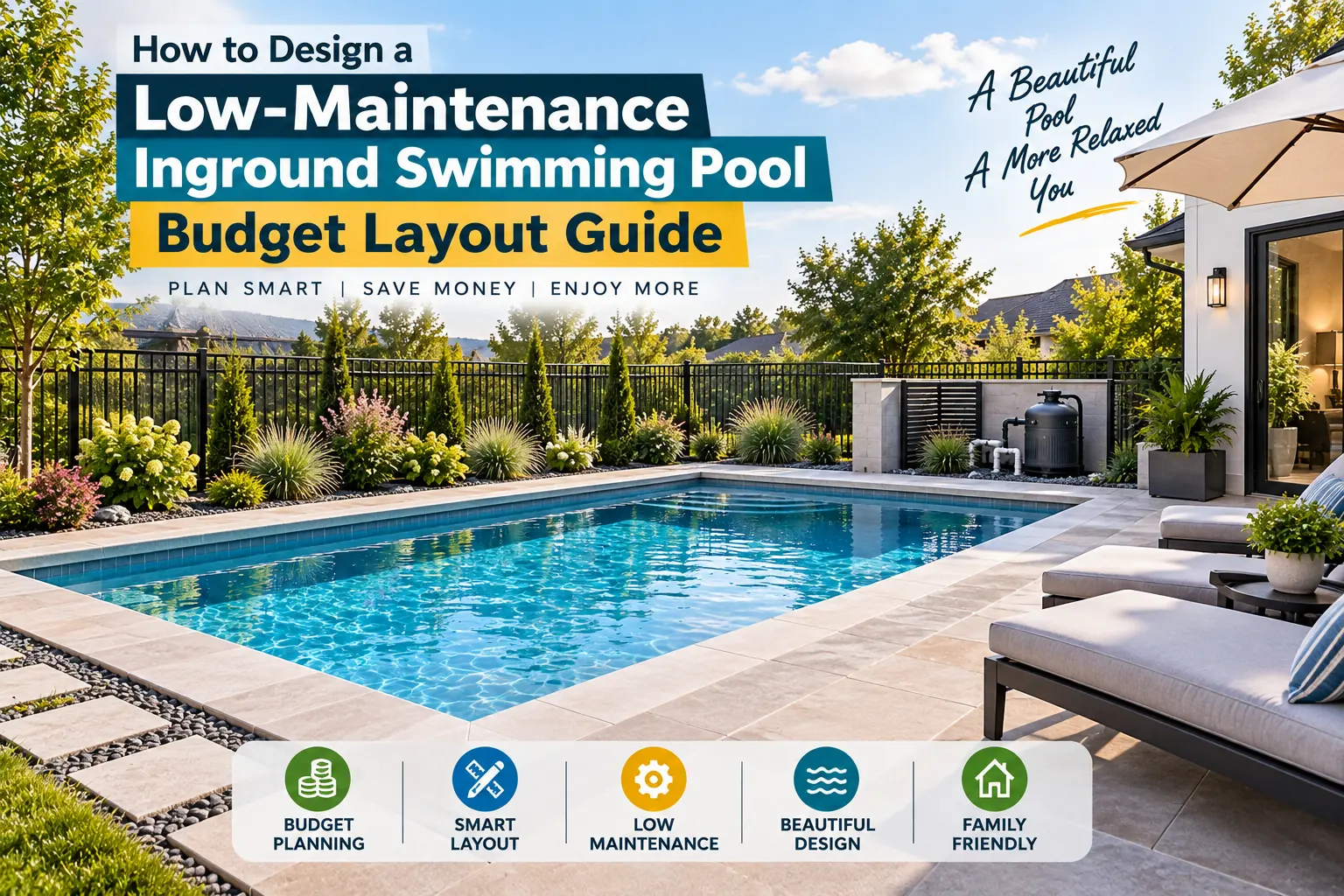
This inground pool budget layout is an illustrative starting point: consider a 12-by-24-foot recreational pool. Place a 10-foot-deep seating patio along one long side and allow four feet of circulation space along the opposite side and each end. That creates a conceptual 26-by-32-foot pool-and-deck rectangle, or 832 square feet, with 288 square feet of water.
These dimensions are planning assumptions, not minimum code clearances or a construction drawing. They exclude the equipment area, cover mechanism, barrier clearances, property setbacks, and planting. Your builder must adjust the plan to local requirements and the selected products.
| Layout element | Illustrative placement | What to verify |
|---|---|---|
| Pool | Center of the activity area | Entry, depth, and usable swimming space |
| Main seating patio | Along one long side | Furniture fits without blocking passage |
| Circulation deck | Other side and both ends | Required clearances and cleaning access |
| Cover storage or housing | Reserved at the appropriate end | Manufacturer’s space requirements |
| Equipment area | Accessible service side of the yard | Clearances, noise, drainage, and access |
| Safety barrier and gate | Planned around the pool area | Local rules and unobstructed operation |
Give this sketch to prospective builders as a discussion brief. Ask them to mark dimensions and exclusions rather than translating a rough drawing directly into a contract.
6. Keep Decking, Drainage, and Planting Straightforward
Spend on enough usable deck for circulation and your actual furniture. Oversized entertaining areas can be added later if the initial plan accommodates them. Compare installed concrete and paver proposals with drainage, repair, and maintenance requirements included. For another outdoor hardscape cost reference, see our custom concrete patio contractor cost guide.
Ask for a drainage plan that keeps surrounding runoff out of the pool and directs water to an approved destination. The correct approach depends on grading, soil, neighboring properties, and local rules. Avoid treating drainage as a landscaping detail to solve after the deck is poured.
For planting, select locally suitable options with manageable mature sizes and limited leaf or fruit drop near the water. Keep loose mulch and gravel from spilling onto the deck. Leave barrier components accessible and avoid positioning climbable furniture or landscaping beside them.
7. Choose Equipment That Saves Work Without Adding Complexity
ENERGY STAR pool-pump guidance explains that variable-speed pumps can match pump speed to the task instead of running at unnecessary high speed. Ask the installer to select and commission the pump for your actual plumbing, filtration, and equipment requirements. A generic daily runtime is not a substitute for that assessment.
Choose a filter you can comfortably maintain. Have the installer demonstrate how it is opened, cleaned, and reassembled, and explain any discharge requirements. Compare access and service needs alongside purchase price.
A compatible robotic cleaner can reduce manual cleaning, but someone still has to empty and maintain it. Keep automation focused on functions you will use. Ask what needs calibration, consumables, replacement parts, or a paid service visit before adding another controller.
8. Plan the Cover and Safety Barrier Together
A cover is more likely to be used when its operation and storage are convenient. ENERGY STAR notes that pool covers can reduce heat loss and keep debris out, reducing cleaning work. Request a cover quote while the pool dimensions are still flexible.
Choose the cover for its stated purpose. A thermal blanket is not a substitute for a safety cover or required barrier. Ask how tracks, anchors, storage, and access will affect the deck layout.
Pool Safely guidance recommends a nonclimbable barrier at least four feet high with a self-closing, self-latching gate as part of layered protection. Local requirements may be stricter. Confirm the applicable rules before construction, and retain attentive adult supervision whenever children are in or near the water.
9. Test the Design Against an Itemized Budget
Here is a hypothetical $80,000 project budget. These amounts are allocation targets, not national price estimates. Replace them with local quotes; some builders bundle several categories together.
| Budget category | Illustrative allocation |
|---|---|
| Pool package, excavation, and basic equipment | $50,000 |
| Decking and drainage | $10,000 |
| Safety barrier and gates | $4,000 |
| Electrical work and permits | $3,000 |
| Cover allowance | $3,000 |
| Landscape repair | $2,000 |
| Contingency held in reserve | $8,000 |
| Total | $80,000 |
This example excludes a spa, heater, outdoor kitchen, major retaining walls, and difficult excavation. The cover allowance does not imply an automatic cover fits that budget. Taxes and package inclusions need checking before the total is treated as complete.
If bids exceed your limit, first revisit optional features, pool size, and discretionary paving. Preserve required safety measures, sound drainage, and proper installation.
10. Budget for Ownership, Not Just Construction
Before accepting the final inground pool installation cost, request an annual operating estimate covering electricity, water, chemicals, cleaning, seasonal opening or closing, and professional service. Add separate reserves for equipment repairs and future surface or liner work. Local climate and your heating preferences can change that estimate substantially.
For perspective, an assumed $200 a month averages $2,400 a year and $24,000 over ten years before inflation or major replacements. That is a calculation example, not a forecast for your pool. Compare builders using the same swimming season and service assumptions.
Walk Through the Maintenance Route on the Plan
Mark the route for cleaning equipment, access to filters and valves, cover storage, and the path used to move supplies. Check that seating and planting will not obstruct those tasks. Ask the builder which maintenance items the proposal assumes you will do yourself. Coordinate surrounding hardscape with our concrete patio planning guide and consider nearby trees using the tree-removal scope guide.
Frequently Asked Questions
What Is the Easiest Inground Pool to Maintain?
Fiberglass is often worth considering for its smooth finish, but no material removes routine care. A manageable size, convenient cover, sensible planting, and accessible equipment also matter when comparing maintenance effort.
Can a Small Pool Still Be Expensive?
Yes. Access, excavation, permits, electrical work, and site preparation do not shrink in direct proportion to the water area. Request the full installed scope before assuming a smaller shell will produce a proportionately smaller bill.
Which Features Should I Leave Out First?
Start with features you would rarely use: a separate spa, elaborate water features, extensive lighting, or oversized paving. Ask whether future additions require provisions now, and price those provisions separately.
How Do I Compare Pool-Builder Quotes Fairly?
Send each builder the same pool dimensions, preferred material, deck area, cover type, and site information. Compare inclusions, exclusions, equipment models, warranties, payment milestones, and responsibility for unexpected work.
A Low-Maintenance Inground Pool Plan You Can Live With
A practical low-maintenance inground pool budget layout makes everyday tasks easy: covering the water, reaching equipment, cleaning the edges, and walking around furniture. Choose a realistic pool size, reserve space for those jobs, and obtain a complete site-specific quote before committing. A simpler finished backyard is more useful than a larger pool that leaves no budget for everything around it.
Sources
Keep reading
Related Articles
Outdoor & Garden
Full Backyard Tree Removal Services Pricing Scale Breakdown
Outdoor & Garden