
Outdoor & Garden
How to Prevent Backyard Soil Erosion on a Steep Slope
FixingManual guide: Learn how to prevent soil erosion on a steep backyard slope with runoff fixes, suitable plants, erosion blankets, and signs you need professional help.

Image disclosure: Images are AI-generated illustrations, not photographs of FixingManual projects or hands-on product tests.
If you are learning how to prevent soil erosion on a slope, start by finding where the water enters and leaves. A muddy strip along your patio after every storm is easy to dismiss. But when the same hillside keeps losing soil, spreading another bag of grass seed rarely fixes the cause. Water may be arriving too quickly, the ground may be poorly covered, or the lawn may be struggling in conditions it cannot tolerate.To prevent backyard soil erosion on a steep slope, address the runoff source, protect exposed soil, and establish vegetation suited to the site. Start with small, stable areas. Deep channels, moving ground, or water emerging from the hillside need professional assessment before landscaping begins.This guide explains how to choose practical erosion control for a sloped backyard without spending money on a solution that washes away in the next storm.First, Check Whether the Slope Is Stable
Surface erosion removes soil from the top of the ground. You might see exposed roots, shallow grooves, or sediment collecting downhill. Slope instability involves movement within the hillside itself, which plants and a seed blanket cannot reliably correct.USGS identifies warning signs such as new ground cracks, bulging soil, unusual seepage, and newly leaning trees or fences. If these appear, keep people away and contact a qualified geotechnical professional. If movement is occurring or people or buildings face immediate danger, move to safety and contact local emergency services. [1]Do not cut into the bottom of a questionable slope, pile fill at its top, or dig a drainage trench across it while waiting for advice. These changes can affect stability. The USGS Landslide Handbook discusses drainage, excavation, and loading as important considerations in slope management. [2]Trace Where the Water Comes From
Look from a safe, stable location during or shortly after rain. Photograph the uphill edge, the damaged area, and the place where sediment collects. Compare several storms if the situation is minor and stable.Your notes should answer three questions: Where does water enter? Does it spread out or gather into a narrow stream? Where does it leave?Common places to inspect include downspout outlets, overflowing gutters, paved edges, and irrigation zones. A strip of dead grass below a roof drain points to a different repair than scattered bare patches under shade trees.Use this checklist to organize what you see before requesting backyard drainage solutions:| What you notice | First question to investigate | Likely next step |
|---|---|---|
| Soil washed below a downspout | Is roof runoff discharging onto bare ground? | Assess a protected route to a suitable outlet |
| Bare patches without a defined channel | Is turf failing from shade, wear, or poor establishment? | Improve plant selection and temporary soil cover |
| A channel that deepens after storms | Is concentrated flow overwhelming the surface? | Request a drainage and erosion assessment |
| New cracks, bulges, or seepage | Could the hillside be moving? | Obtain a geotechnical assessment |
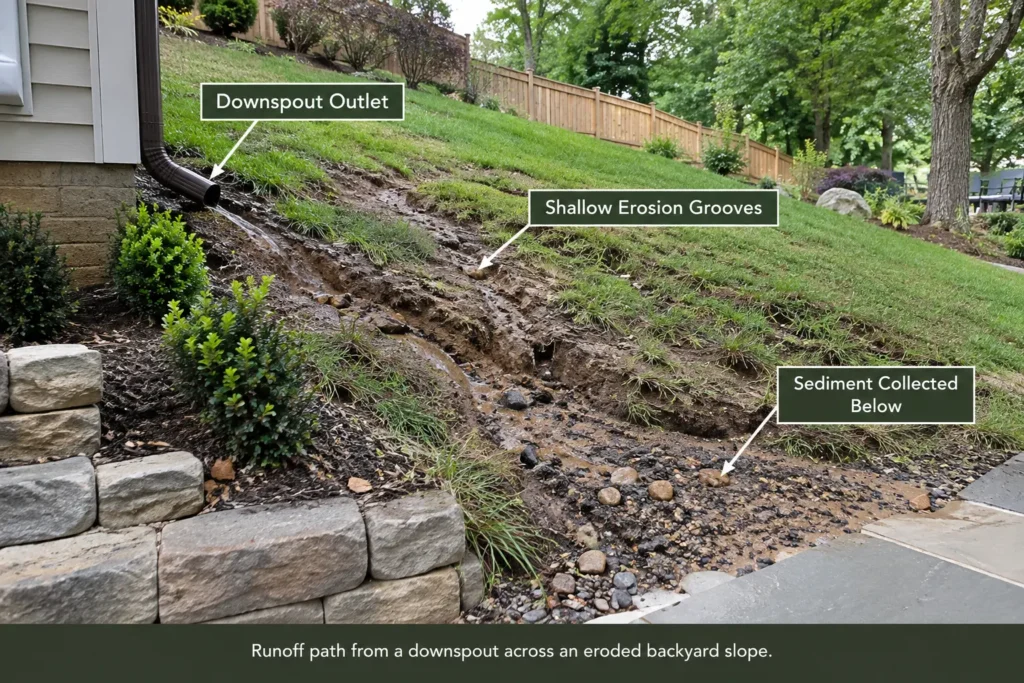
How to Prevent Soil Erosion on a Slope: Fix Runoff First
A planting project needs a workable water-management plan. Ask a drainage professional how roof and pavement runoff can reach an appropriate outlet without cutting through the hillside or threatening foundations.A French drain is not a universal answer to hillside erosion. Before approving French drain installation, ask what water it will collect, how it will function, where it will discharge, and how the outlet will be protected. A quote that names a pipe but does not explain its outlet leaves a major question unanswered.Rain gardens also require suitable site conditions. Do not dig an infiltration basin into a steep or potentially unstable slope. Missouri Botanical Garden identifies setbacks from buildings and property lines, along with other site limitations for rainscaping. Have the proposed location assessed rather than assuming that soaking more water into the hillside will help. [3]Check proposed discharge routes with your local stormwater office when needed. Avoid directing runoff toward neighboring property, septic areas, or building foundations.Keep Existing Soil Cover While You Work
It is tempting to clear the whole hill and start over. That can leave a larger area exposed just when a storm arrives.University of Minnesota Extension recommends limiting disturbance, preserving vegetation, and stabilizing one small area before opening another. Keep healthy plants and protect established tree roots while repairs proceed. [4]For a stable slope with scattered damage, divide the project into manageable sections. Plan the work so each disturbed section receives appropriate protection promptly. Avoid beginning a large clearing project immediately before forecast heavy rain.Keep material deliveries and repeated foot traffic off vulnerable ground. If access requires walking across a slippery or precarious hillside, hire a crew equipped for those conditions. Saving on installation is not useful if the work cannot be done safely.Replace Struggling Turf With Suitable Plants
Grass can protect soil where it grows densely. It becomes a poor investment when the same steep, shaded strip needs reseeding every season.For steep slopes, Purdue Extension recommends considering a mixture of grasses, herbaceous and woody ground covers, shrubs, and trees where space allows. Match plants to the growing conditions instead of choosing solely by appearance. [5]Before buying ground cover for erosion control, write down the site’s sunlight, soil moisture, winter climate, and available maintenance access. Ask your county Extension office or a knowledgeable local nursery for noninvasive options suitable for those conditions.Choose plants for the whole site
A sunny upper section and a damp lower section may need different plants. In many US regions, locally appropriate native grasses, sedges, perennials, and shrubs can form part of the plan. “Native” alone does not mean a plant will tolerate every position in your yard.Avoid a universal shopping list based on a distant garden photograph. Check mature size, spacing, regional invasiveness, and the water needed during establishment.Budget for coverage between plants
Small plants take time to spread. Account for temporary erosion protection between them, rather than leaving open soil and expecting future growth to solve an immediate problem.Use the recommended spacing for the selected plants. Buying fewer plants may reduce the initial bill, but it can extend the period when the surface needs attention.Use Erosion Control Blankets Where Appropriate
An erosion control blanket protects exposed soil while vegetation establishes. Natural-fiber products may contain straw, coir, or other fibers. Massachusetts homeowner guidance identifies these blankets as an option for covering exposed surfaces. [6]Select the product for the actual slope, expected conditions, and establishment period. Follow its installation instructions, including soil contact, anchoring, and overlaps. A blanket laid loosely across uneven ground may leave paths for water underneath.For very steep ground or concentrated flow, ask an erosion-control contractor to specify the system. An ordinary seed blanket is not automatically suitable for a drainage channel.Check the netting as well as the fiber filling. The US Fish and Wildlife Service recommends wildlife-friendly products using fully biodegradable materials and flexible, loose-weave netting or no netting where appropriate. Plastic mesh can entangle animals. [7]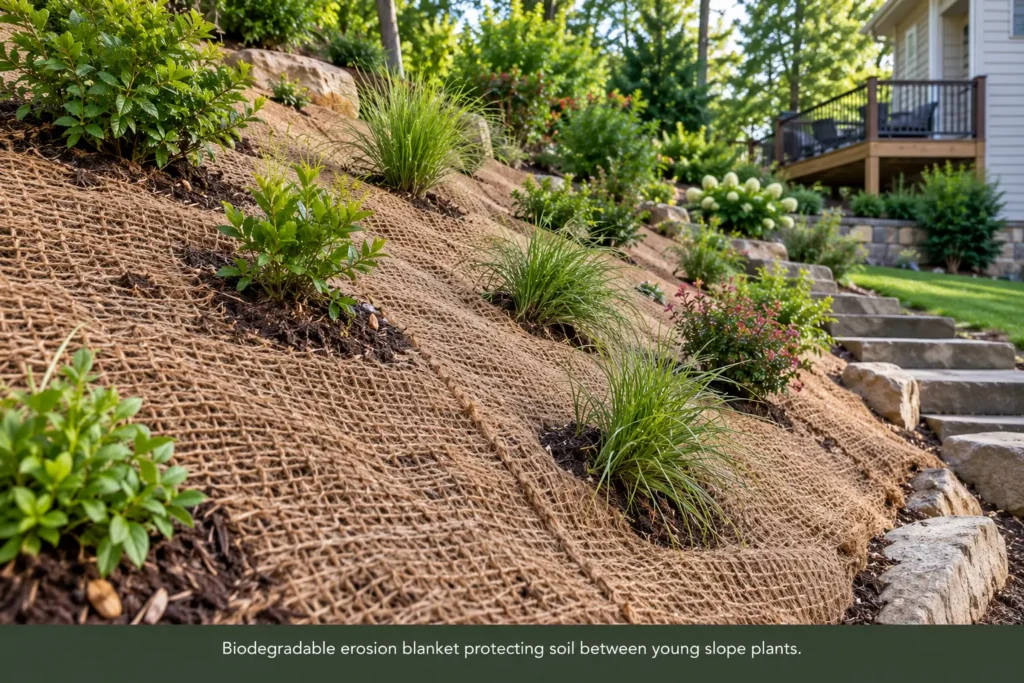
Know When Mulch, Rock, or Retaining Walls Make Sense
Loose decorative mulch can move when water gathers into a stream. Even specialized compost blankets have limits: EPA advises against placing them where concentrated or channeled flows occur. [8]Do not assume a layer of gravel will solve the same problem. Ask how the proposed surface will remain stable and what happens to the water entering and leaving it.Retaining wall installation and terraced landscaping can be appropriate parts of a professionally designed project. However, a wall must account for soil, drainage, loads, and site conditions. A decorative garden border is not interchangeable with a structure holding back a hillside.Before accepting a wall proposal, ask whether engineering and permits are required locally. Request a drawing that explains drainage and the work limits. Avoid excavating terraces into a steep slope based only on a photograph or a general online tutorial. Structural slope work needs site-specific judgment. [2]Plan the Budget Around the Cause
There is no useful single price for backyard slope stabilization without knowing the area, access, runoff source, and scope. Planting a stable bare patch is a different project from drainage construction or an engineered retaining wall.Request separate prices for assessment, runoff work, surface protection, planting, and follow-up care. This makes contractor estimates easier to compare and shows which items are essential to the proposed repair.For example, imagine a stable slope where one downspout feeds a small eroded patch. A sensible proposal would explain the runoff correction first, then specify patch protection and planting. A quote for reseeding the entire yard should explain why that extra work is necessary.Ask each bidder:- What is causing the erosion, and what observations support that conclusion?
- Which work requires engineering, permits, or utility locating?
- What products and plants are included, with quantities and coverage areas?
- Who handles watering, inspections, repairs, and plant replacement?
Maintain the Repair Through Establishment
After rainfall, check from safe ground for renewed grooves, displaced cover, exposed plant roots, and sediment at the bottom. Photograph the same locations so small changes are easier to spot.Follow the planting plan for irrigation. Check actual soil moisture and weather before running a fixed schedule; new plants need establishment care, but constant watering should not be the default.Keep people and pets from creating worn paths through recovering areas. If water repeatedly breaks through the same location, ask the installer to reassess the cause instead of repeatedly covering the damage. Keep records of those visits and any changes to the drainage plan.Keep a Rain Observation Record
From a safe location, photograph the same areas before and after rain. Note where water enters, where sediment collects, and whether existing cover is changing. Share that record with the professional assessing the cause. Do not approach a slope showing movement or other instability. If a wall is proposed, compare its drainage and engineering scope with our retaining wall planning guide rather than treating it as a decorative fix.
Frequently Asked Questions
What is the cheapest way to stop erosion on a slope?
For a small, stable area, preserving existing vegetation and addressing a localized runoff problem may keep the scope manageable. Price the cause first. Repeatedly replacing washed-out seed can cost more than a focused repair.Will grass seed alone stop hillside erosion?
It may establish on a suitable site, but exposed seed offers little immediate protection. Success depends on growing conditions, runoff, preparation, and temporary surface protection while plants develop.Do all steep backyards need a retaining wall?
No. Some stable slopes can be managed with vegetation and appropriate erosion protection. Others need drainage or structural work. An assessment should establish the need before you commit to a wall.How long does slope planting take to work?
There is no universal timeline. Species, planting size, season, and weather affect establishment. Ask your installer what coverage to expect and how the soil will stay protected until plants fill in.Build a Repair You Can Maintain
Preventing soil erosion on a slanted lawn starts with understanding the water and the ground beneath it. Preserve healthy cover, correct the runoff problem, and give new planting protection while it establishes. For deep erosion or signs of slope movement, get the right professional involved before changing the hillside. A clear plan is easier to maintain than a cycle of washed-out soil and repeated repairs.Sources
[1] USGS: Signs of landslide development[2] USGS: The Landslide Handbook[3] Missouri Botanical Garden: Stabilize steep slopes[4] University of Minnesota Extension: Planning and protecting shoreland landscapes[5] Purdue Extension: Plants for steep slopes[6] Massachusetts: Preventing erosion at home[7] US Fish and Wildlife Service: Wildlife-friendly erosion control[8] EPA: Compost blanketsKeep reading
Related Articles

Outdoor & Garden
How to Design a Low-Maintenance Inground Pool Budget Layout

Outdoor & Garden