
Home Systems & Energy
Whole House Generator Installation Costs for Power Outage Backup
Compare whole house generator installation costs, transfer switch requirements, fuel options, permits, and maintenance expenses before requesting a standby generator quote.
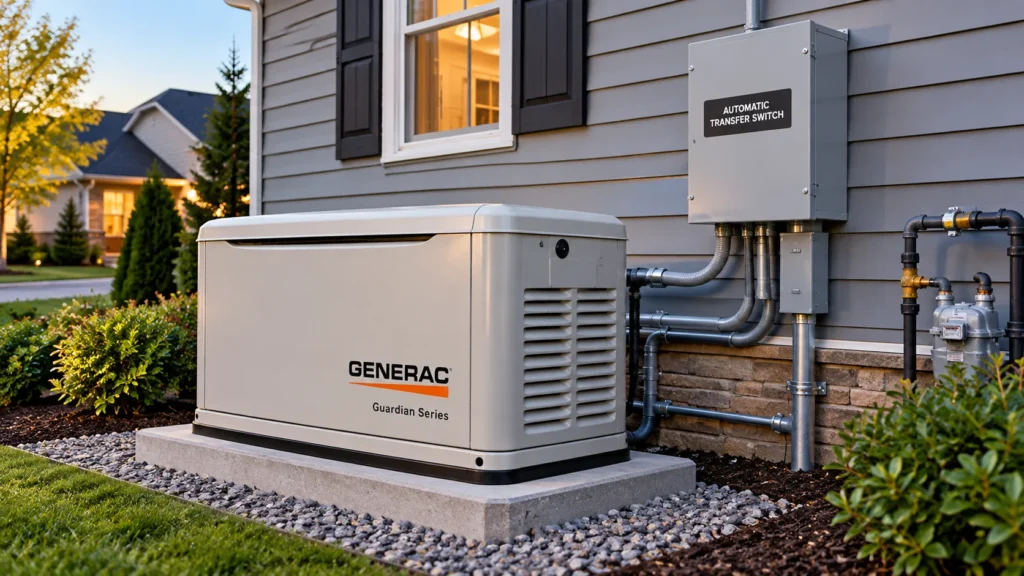
Image disclosure: Images are AI-generated illustrations, not photographs of FixingManual projects or hands-on product tests.
Whole house generator installation cost depends on more than the generator itself. A permanently installed standby generator can start automatically during an outage and supply selected circuits or most of a home. A safe installation may also require an automatic transfer switch, concrete or composite pad, electrical work, gas piping, permits, load management, and changes to the utility meter or service.
For a published screening reference, HomeGuide’s whole-house generator guide lists about $6,000–$11,000 installed and $9,500–$24,000 for its long-distance or larger-than-20-kW category. These are broad guide ranges, not a quote or a capacity recommendation. Fuel supply, utility work, access, and the actual load design can change the total.
Whole House Generator Installation Cost Overview
| Published reference category | Installed guide range | Limit |
|---|---|---|
| General whole-house category | $6,000–$11,000 | Verify the supported loads and included work |
| Long-distance or larger-than-20-kW category | $9,500–$24,000 | A source category, not a system-sizing rule |
“Whole house” can mean different things. One system may energize the full panel but automatically pause the air conditioner or electric range. Another may be sized to run nearly every major load at once. Make the contractor list what will and will not operate during an outage.
What Is Included in a Standby Generator Installation?
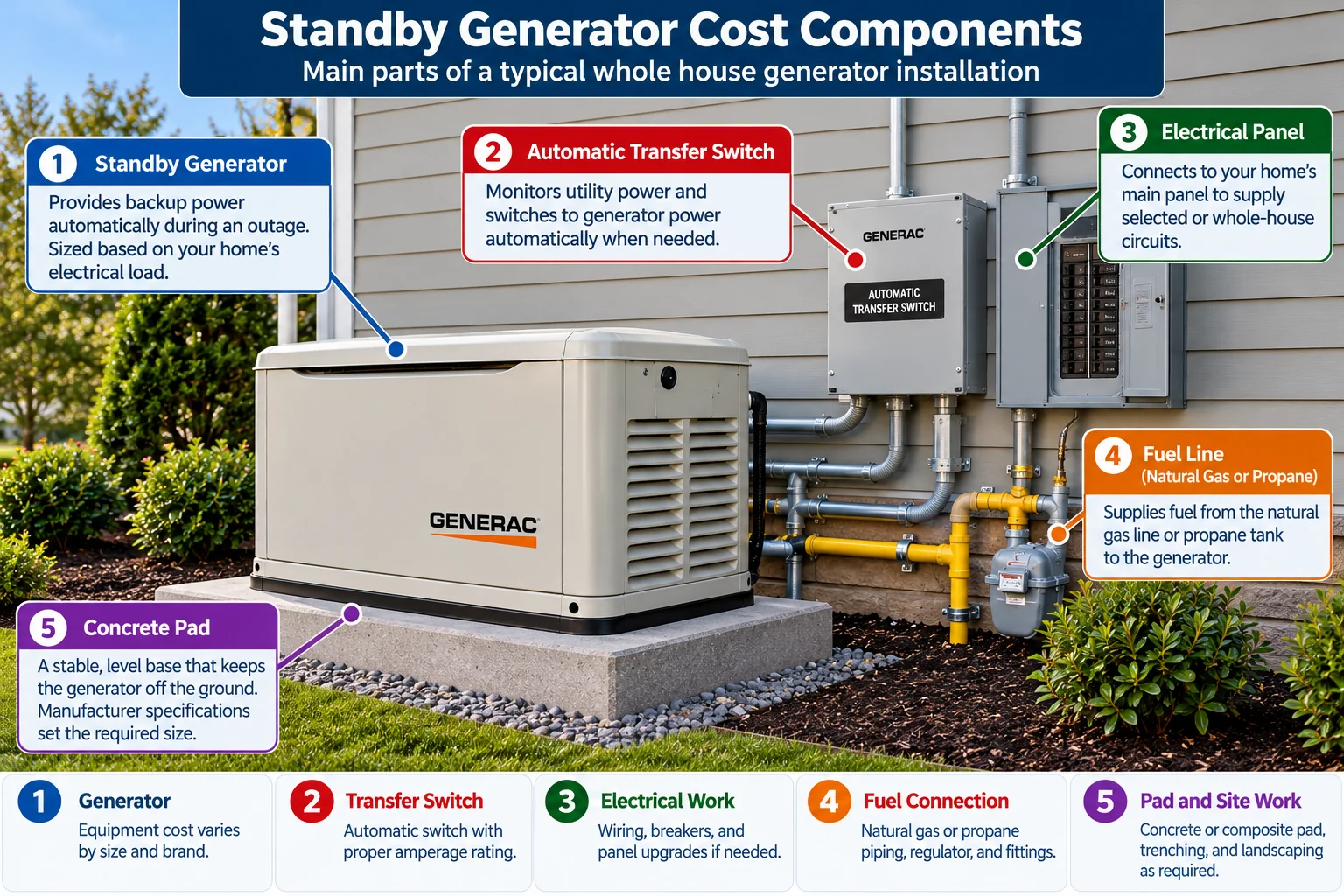
A complete proposal should identify the generator model and rated output on the selected fuel, transfer-switch type and amperage, covered circuits or load-management modules, pad, wiring, fuel piping, startup, battery, permits, inspection, and owner orientation. It should state who coordinates the electric utility and gas utility.
Also look for exclusions such as trenching, landscaping repair, propane tank, gas-meter upgrade, electrical-panel replacement, concrete cutting, snow protection, remote monitoring fees, and the first maintenance visit.
Major Factors That Change Installation Price
Generator capacity
Capacity is based on electrical load, not just square footage. Motors and compressors need extra power when starting. A contractor should inventory essential and optional loads, then account for startup demand and load management. Oversizing wastes money and may reduce operating efficiency; undersizing can overload the unit.
Transfer switch and electrical scope
An automatic transfer switch isolates the house from the utility before connecting generator power. This prevents dangerous backfeed and protects workers. The project may involve a service-rated switch, panel modifications, surge protection, or replacement of obsolete equipment. If the panel also needs replacing, review the cost of upgrading from a 100-amp to a 200-amp electrical panel while comparing estimates. Only qualified professionals should perform this work under local permit rules.
Fuel supply
Natural-gas capacity depends on available pressure, meter rating, pipe length, and other appliances. A larger meter or pipe may be needed. Propane systems require a properly sized tank, regulator, and placement. The generator’s output can differ by fuel, so the proposal should show the rating used in the load calculation.
Site preparation and clearances
The unit needs a stable, level base and manufacturer-required clearance from openings, combustibles, property lines, and other equipment. Exhaust must never enter the home. Flood zones, snow accumulation, roof runoff, fences, slopes, and local noise limits can change the location and cost.
Permits and utility coordination
Electrical, mechanical, gas, zoning, and environmental requirements vary. Some projects require utility shutdowns or inspections before activation. A bid that omits permitting may look cheaper but create delays or problems at resale.
Sample Installed-Cost Breakdown
| Quote component | Record from each bidder |
|---|---|
| Generator and transfer equipment | Model, fuel-rated output, switch, and included accessories |
| Electrical work | Wiring, panel changes, load controls, and labor |
| Fuel work | Pipe route, meter/tank work, and utility responsibility |
| Site work | Base, excavation, restoration, permits, and startup |
| Ongoing costs | Fuel assumptions, service, monitoring, and warranty exclusions |
Use this scope table to identify omissions. Compare complete installed proposals for the same loads and avoid counting an item twice when one contractor bundles equipment and labor.
How to Estimate Your Whole House Generator Installation Cost
Use these five steps to prepare a realistic installation budget before contacting local contractors:
- Choose your outage essentials. List the refrigerator, heating equipment, sump or well pump, lighting, medical equipment if applicable, and communications that must stay powered.
- Request a professional load calculation. Ask the installer to consider motor starting loads and whether automatic load management can reduce the generator capacity needed.
- Check the installation site. Record the proposed generator location, approximate distances to the electrical panel and fuel source, and any obstacles or drainage concerns. The contractor must confirm safe clearances.
- Identify extra work. Ask whether the quote includes the automatic transfer switch, permits, trenching, fuel piping, inspections, panel changes, and restoration of disturbed landscaping.
- Compare the full ownership cost. Compare written installed prices alongside fuel use, expected maintenance, warranty coverage, and local service availability.
Use the cost tables above as planning ranges rather than guarantees. A written, site-specific proposal should clearly explain what the generator can power, what equipment is included, and which services cost extra.
Essential-Load vs Whole-Home Backup
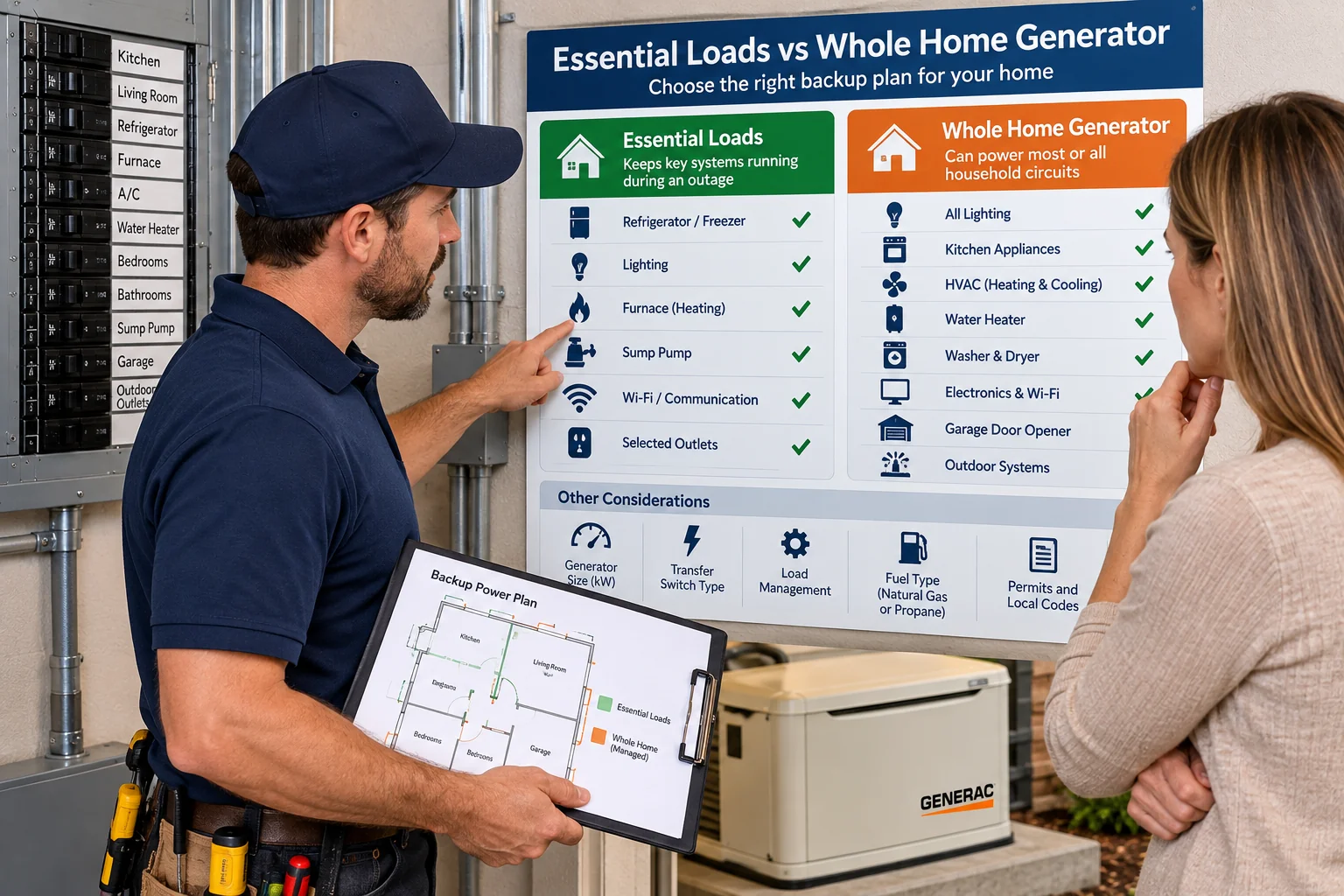
An essential-load design can keep the refrigerator, well pump, furnace blower, sump pump, communications, and selected lighting available while excluding large discretionary loads. During winter outages, a working heating system matters too; our emergency furnace repair guide explains when professional help may be needed. Essential-load designs usually cost less and use less fuel.
A managed whole-home system connects more circuits but sheds or delays selected loads when demand rises. This can support a comfortable outage plan without buying the largest generator. Ask which loads receive priority, whether the homeowner can change priorities, and what happens if communications between modules fail.
Large electric resistance heat, multiple air conditioners, EV charging, pools, and electric water heating can drive capacity sharply upward. If central cooling is a priority, review the home’s central air-conditioning system and installation considerations when listing major loads. Decide what truly needs to operate simultaneously.
Operating and Maintenance Costs
Budget beyond installation. Standby generators perform periodic exercise cycles, consume fuel during outages, require oil and filter service, use a starting battery, and may have monitoring subscriptions. Service intervals depend on the manufacturer, run hours, and conditions. Long outages may require more frequent checks.
Ask for the expected fuel use at several load levels, not only at maximum output. Confirm who can obtain parts locally and how quickly the dealer responds after a regional storm, when many customers may need service at once.
Generator Safety Is Part of the Project
Generator exhaust contains deadly carbon monoxide. A standby unit must be outdoors and located exactly as required by the manufacturer and local authorities. Never build an enclosure, stack items around the unit, or modify exhaust clearances without written approval.
Install and maintain carbon monoxide alarms on every level and near sleeping areas, following alarm instructions. Keep vegetation, snow, leaves, and stored materials away from the generator. A portable generator is not a substitute for a standby installation unless it is used outdoors at the required distance and connected through approved equipment; never plug it into a household outlet.
How to Compare Generator Installation Quotes
Request at least two detailed proposals. Each should include the load calculation, generator output on your fuel, transfer-switch rating, circuit strategy, pipe sizing, trench distance, site plan, clearances, permits, utility work, startup test, warranty, and maintenance options.
Ask:
- Which appliances will operate together during an outage?
- Is a gas-meter or electrical-service upgrade included?
- Who handles permit and utility applications?
- How will the unit be protected from flooding and drifting snow?
- Does the price include landscaping and wall repairs?
- What labor warranty and emergency-response terms apply?
Verify the electrical and fuel-gas credentials required in your jurisdiction. Avoid cash-only deals, open-ended allowances without approval limits, or anyone suggesting an unpermitted backfeed connection.
Ways to Keep the Project Affordable
Prioritize essential loads before selecting capacity. Place the unit where safe clearances are met without an unnecessarily long trench or fuel run. Coordinate a panel upgrade or other electrical work if it is already planned, but keep each cost item visible. Compare natural gas and propane using local availability and outage resilience, not fuel price alone.
Check current federal, state, local, insurer, and utility programs. Incentives for generators are limited and eligibility can be narrow, so obtain written program terms before including a credit in the budget.
A Backup-Load Handover Checklist
Before accepting the installation, ask the installer to demonstrate the outage sequence and record which circuits remain available. Keep the generator model, fuel rating, transfer equipment, load priorities, shutdown instructions, and service contact together. Write down what happens when heating, a pump, and cooling call for power at the same time. For related electrical planning, compare the scope with our 200-amp service upgrade guide.
Frequently Asked Questions
How long does installation take?
On-site work may take several days, but design, permits, utility coordination, inspections, and equipment delivery can make the overall schedule several weeks or longer.
Can a generator power central air conditioning?
Yes, if the generator, transfer equipment, and load controls are designed for the compressor’s starting and running demand. Do not assume a nameplate watt total is sufficient.
Does a standby generator add home value?
It can improve resilience and buyer appeal in outage-prone areas, but resale value varies and rarely guarantees full cost recovery. Choose it primarily for household needs.
The Bottom Line
Start with the published cost references above, then obtain inspected proposals for your property. The most useful estimate defines supported loads, transfer protection, fuel capacity, site work, permits, and ongoing service. A broad national range cannot replace those details.
Sources
Keep reading
Related Articles
Home Systems & Energy
Aluminum Wiring Pigtail Repair Cost for an Older Home
Home Systems & Energy