
Roofing & Exterior
Commercial Roof Restoration vs. Replacement: ROI & Decision Guide
Compare commercial roof restoration and replacement through moisture findings, manufacturer eligibility, complete quotes, warranty scope, and project-specific tax advice.
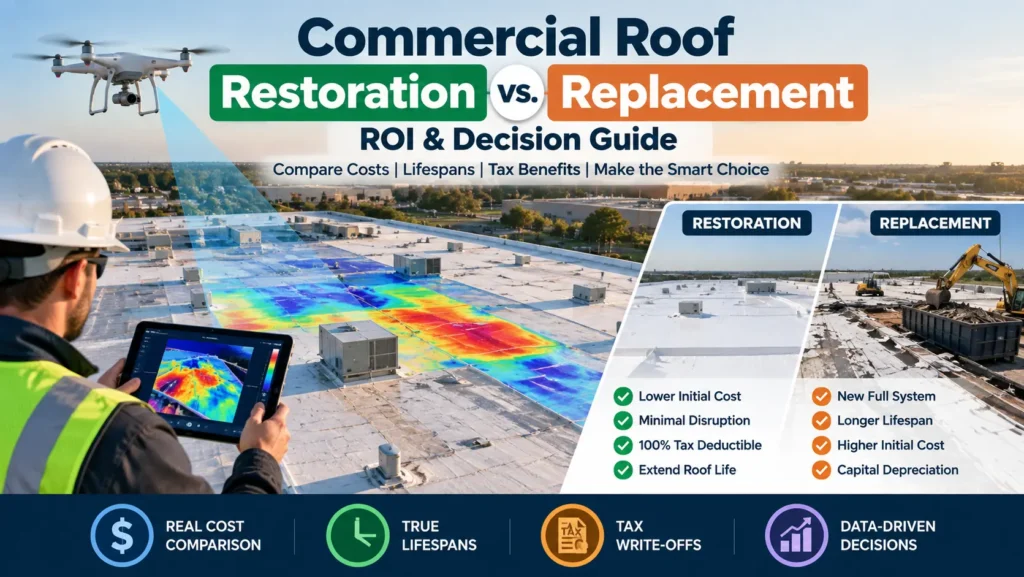
Image disclosure: Images are AI-generated illustrations, not photographs of FixingManual projects or hands-on product tests.
Commercial roof restoration can be a strong option when a large low-slope roof is aging but the underlying system is still structurally sound and mostly dry. A full replacement, by contrast, removes the existing roof assembly and rebuilds the system from the structural deck upward.
For property managers and building owners, the decision is not simply “repair versus replace.” It is a capital-planning question involving installation cost, remaining roof life, moisture conditions, operational disruption, warranty requirements, and tax treatment. This guide compares the two paths using a practical 25,000-square-foot commercial-roof example.
Before choosing either option, document the roof condition with a professional inspection. Infrared scanning, core cuts, seam evaluation, and deck assessment can reveal whether restoration is technically appropriate or whether replacement is the safer long-term investment.
Commercial Roof Restoration vs. Replacement: What Is the Difference?
What Is Commercial Roof Restoration?
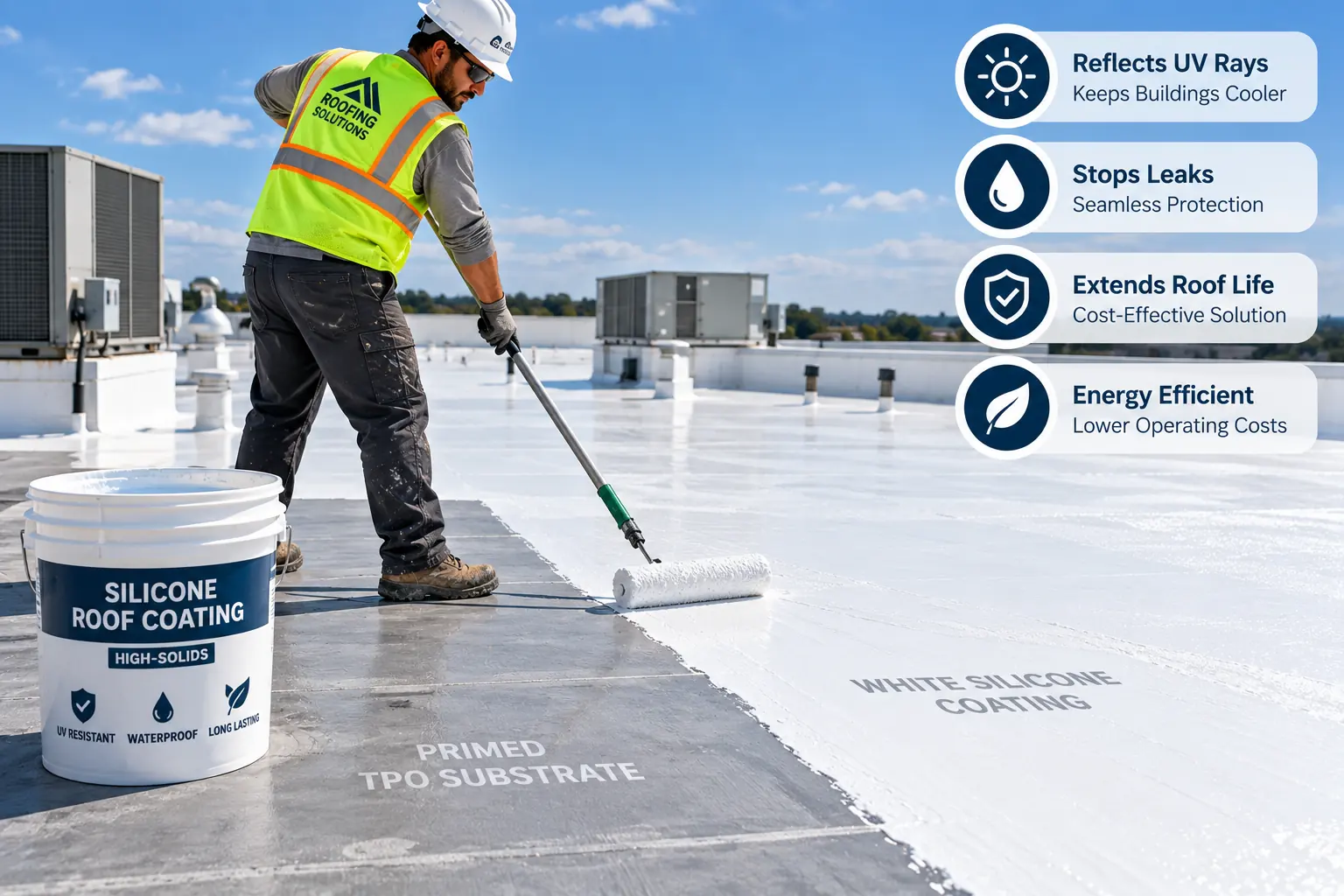
Commercial roof restoration is a systematic process in which an existing weathering membrane—such as TPO, PVC, EPDM, or modified bitumen—is cleaned, repaired, prepared, primed where required, and covered with a compatible fluid-applied coating. The finished coating forms a seamless protective surface designed to improve weather resistance and reduce ultraviolet exposure.
Restoration only makes sense when the existing roof system is suitable for coating. Wet insulation, failed attachment, severe membrane deterioration, or structural deck damage can require selective removal or a full replacement instead.
What Is a Full Commercial Roof Replacement?
A full replacement removes the existing roofing system down to the structural deck. The new assembly may include a vapor retarder, insulation, cover board, a new TPO, PVC, EPDM, modified-bitumen, or other approved membrane, plus perimeter and penetration details.
Replacement costs more because it combines demolition, disposal, new insulation and membrane materials, lifting and staging, additional labor, and greater business disruption. It also provides a fully new roof assembly rather than extending the life of the existing one.
Commercial Roof Restoration Cost vs. Replacement Cost
Compare restoration and tear-off proposals on the same measured area and defined scope. The table identifies costs to obtain from bidders; it is not a national price survey.
| Item to compare | Fluid-applied restoration | Full tear-off replacement |
|---|---|---|
| Base scope | Cleaning, compatible preparation, detail repairs, coating system | Removal, disposal, new roof assembly, and details |
| Condition-dependent work | Wet-area removal, substrate repairs, and drainage corrections | Deck repairs, insulation changes, and drainage corrections |
| Service and warranty | Obtain system-specific terms and maintenance requirements | Obtain assembly-specific terms and maintenance requirements |
| Area and quantity | Measured coating area and specified coverage | Measured roof area and complete assembly quantities |
| Complete price | Base quote plus identified exclusions | Base quote plus identified exclusions |
For an arithmetic illustration only, assume two complete proposals for a 25,000-square-foot roof are $125,000 and $275,000. Their comparable rates would be $5 and $11 per square foot. These invented figures explain the calculation; they are not researched market prices. Check whether each total includes wet-area removal, insulation, drainage, permits, and warranty costs before comparing.
A Step-by-Step Roof Restoration Eligibility Framework
1. Map Moisture Before Signing a Coating Contract
Infrared thermography can help identify areas that may retain moisture by comparing temperature patterns across the roof. It should be interpreted by qualified professionals and, where appropriate, confirmed with additional testing such as core cuts or other moisture-verification methods.
Do not use a generic wet-area percentage to approve a coating. GAF’s liquid-applied roofing manual, for example, requires moisture assessment, removal of wet insulation, and system-specific substrate preparation. Its guarantee program has its own eligibility criteria. Have the designer and manufacturer confirm the criteria for the proposed roof; another system may differ.
2. Inspect Seams, Fasteners, and Membrane Condition
Inspect open seams, punctures, backed-out fasteners, failed flashings, edge conditions, and widespread membrane degradation. A coating system still depends on a properly prepared and repairable substrate.
3. Check the Structural Deck
Evaluate the underside of the roof where accessible. Corrosion on steel deck, concrete deterioration, or wood decay can change the project from a surface restoration into a structural repair or replacement project.
Fluid-Applied Roof Coating Options
High-Solids Silicone Roof Coating
Ask the coating manufacturer to identify an approved silicone system for the existing substrate and drainage conditions. Compare preparation, primer, repairs, required coating thickness, curing conditions, and written coverage. A silicone label alone does not establish that the entire roof is eligible or that ponding can be ignored.
Water-Based Acrylic Roof Coating
Acrylic systems require the same product-specific review. Check substrate compatibility, drainage limitations, application weather, and maintenance. Request complete installed proposals rather than assuming one coating chemistry always costs less or lasts a fixed number of years.
Why Full Commercial Roof Replacement Costs More
A replacement project involves much more than installing a new membrane. Costs can include tear-off labor, disposal, cranes or material lifts, new insulation and cover board, perimeter metal, safety staging, adhesives or fasteners, interior protection, and additional project supervision.
The benefit is a new roof assembly with a longer service horizon and the opportunity to correct saturated insulation, unsuitable slope, widespread attachment problems, or deck deterioration. If the existing roof has already failed at the system level, restoration may only delay the inevitable.
Tax Treatment: Do Not Assume Restoration Is Always Fully Deductible
Tax treatment depends on the facts and circumstances of the project. IRS guidance distinguishes deductible repair and maintenance expenses from capital improvements that must generally be capitalized. A project that replaces a major component or materially improves the property may be treated differently from routine repair or maintenance.
Ask your tax professional to review the actual scope, ownership, placed-in-service date, and current rules. A roof project may involve capitalization, depreciation, or a qualifying election; the contractor’s label and payment date alone do not determine the result.
See the IRS Publication 946 depreciation guidance and the IRS tangible-property regulations overview for current federal guidance.
Common Commercial Roof Restoration Mistakes
- Skipping moisture diagnostics. Coating over hidden wet insulation can trap a problem that should have been removed first.
- Ignoring ponding-water conditions. The coating chemistry must match the actual drainage conditions and manufacturer requirements.
- Underestimating cleaning and primer requirements. Adhesion depends on correct substrate preparation, repairs, and compatible primers.
- Comparing bids with different scopes. One contractor may include wet-insulation replacement, edge repairs, and warranty fees while another does not.
Safety, Insurance, and Operational Planning
Commercial roofing work requires careful safety and access planning. Verify contractor licensing where applicable, liability insurance, workers’ compensation coverage, and the site-specific fall-protection plan. OSHA fall-protection requirements should be incorporated into the contractor’s work practices.
Full tear-offs can also create noise, vibration, odors, temporary interior protection needs, and loading-zone conflicts. Plan around tenant schedules, manufacturing operations, deliveries, and sensitive interior spaces before construction starts.
If your building is dealing with an active leak or storm-related damage before a larger capital project begins, see our emergency roof repair cost guide for short-term planning considerations.
Commercial Roof Restoration vs. Replacement: Decision Checklist
| Question | Restoration may fit when… | Replacement may fit when… |
|---|---|---|
| Is insulation mostly dry? | Yes, with isolated wet areas that can be removed | No, moisture is widespread or systemically distributed |
| Is the structural deck sound? | Yes | No, structural repair is required |
| Are seams and details repairable? | Yes | Failures are widespread or attachment is inadequate |
| Is lower disruption important? | Restoration usually creates less tear-off activity | Replacement requires more staging and removal |
| Is a new full roof assembly required? | No | Yes |
Compare Options Over the Same Evaluation Period
List each option’s initial scope, excluded repairs, inspection and maintenance obligations, warranty terms, and expected future work. Use the same period and assumptions for both scenarios rather than treating the cheapest first invoice as the best return. Ask the manufacturer or qualified designer to confirm restoration eligibility for the actual roof. Compare replacement scopes using our commercial roofing contractor guide.
Frequently Asked Questions
How Much Does Commercial Roof Restoration Cost?
Obtain an inspected, itemized local proposal. The price depends on roof area, substrate condition, wet-area removal, drainage, preparation, access, coating specification, and warranty scope. A price per square foot without those assumptions is incomplete.
When Is Roof Replacement Better Than Coating?
Replacement becomes more appropriate when insulation is widely saturated, the deck is structurally compromised, attachment is inadequate, or the existing roof cannot provide a suitable substrate for restoration.
Can a Silicone Coating Be Applied Over TPO?
Potentially, but the existing TPO must be evaluated, cleaned, repaired, and prepared according to the coating manufacturer’s approved system. Primer and adhesion requirements vary by product.
Is Commercial Roof Restoration Always 100% Tax Deductible?
No. Federal tax treatment depends on the project scope and the applicable capitalization rules. Some work may qualify as repair or maintenance, while other work may be a capital improvement. Certain qualifying roof improvements to nonresidential real property may also be eligible for Section 179 treatment. Consult a tax professional for the specific project.
Final Commercial Roofing Decision Framework
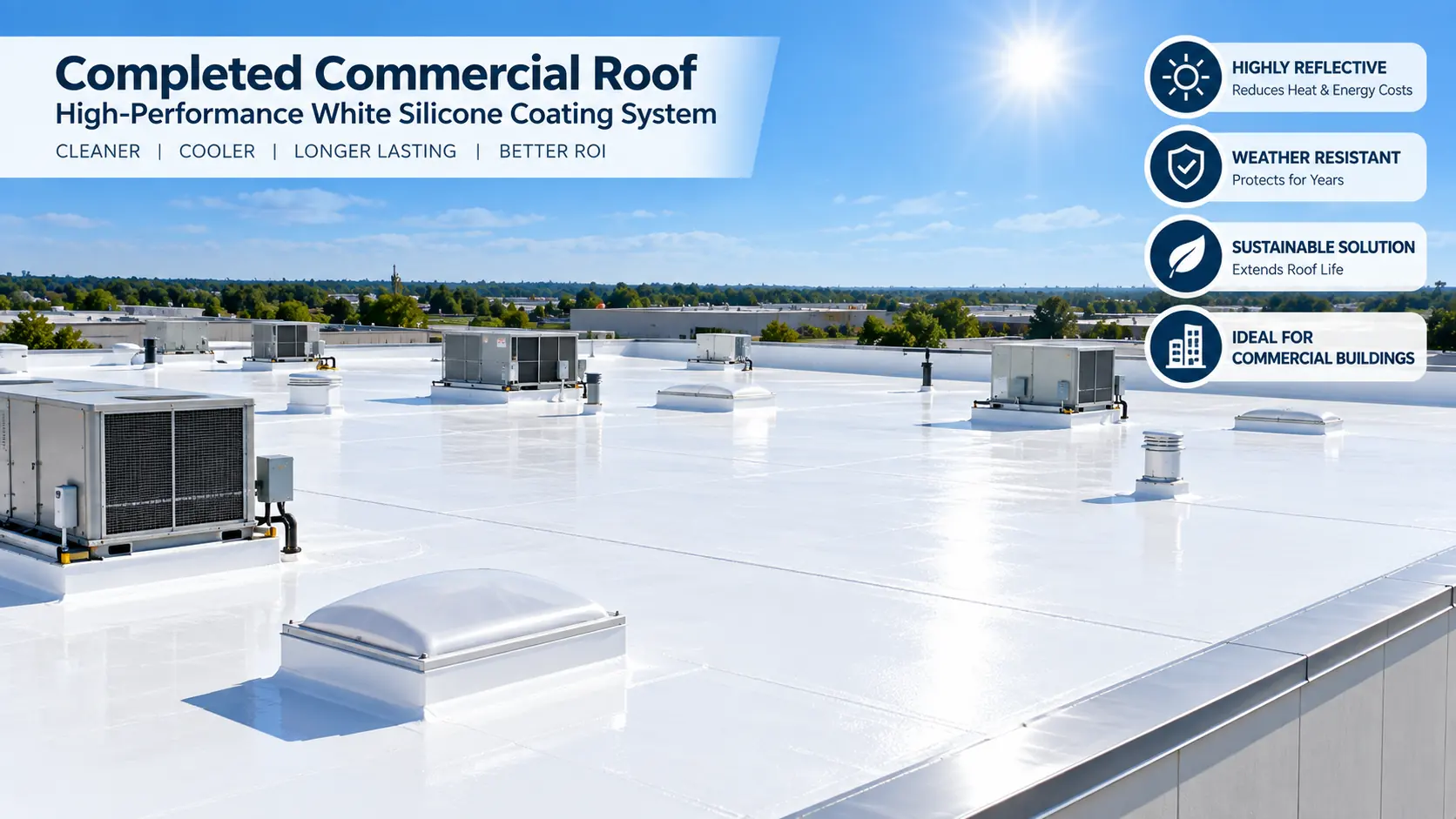
Commercial roof restoration can preserve capital, reduce disruption, and extend the life of a suitable existing roof. Full replacement is the stronger choice when the roof assembly is saturated, structurally compromised, or too deteriorated to support a reliable restoration system.
The best decision starts with condition data rather than a sales pitch. Use moisture mapping, physical verification, detailed scope comparisons, manufacturer requirements, and tax advice to decide whether extending the current system or installing a new one produces the better long-term result for the building.
Sources and Editorial Note
The numerical roof-price example above is hypothetical. Technical eligibility must follow the selected manufacturer’s current specification and an actual roof assessment. Linked IRS material provides background; project-specific tax treatment needs advice from your tax professional.
Keep reading
Related Articles
Roofing & Exterior
How to Choose Asphalt Shingles for Your Next Residential Project
Roofing & Exterior