
Home Systems & Energy
Attic Spray Foam Insulation Cost vs Fiberglass Batts Price
FixingManual guide: Compare attic spray foam insulation cost vs fiberglass batts price, including installation, roofline differences, hidden expenses, and contractor quotes.
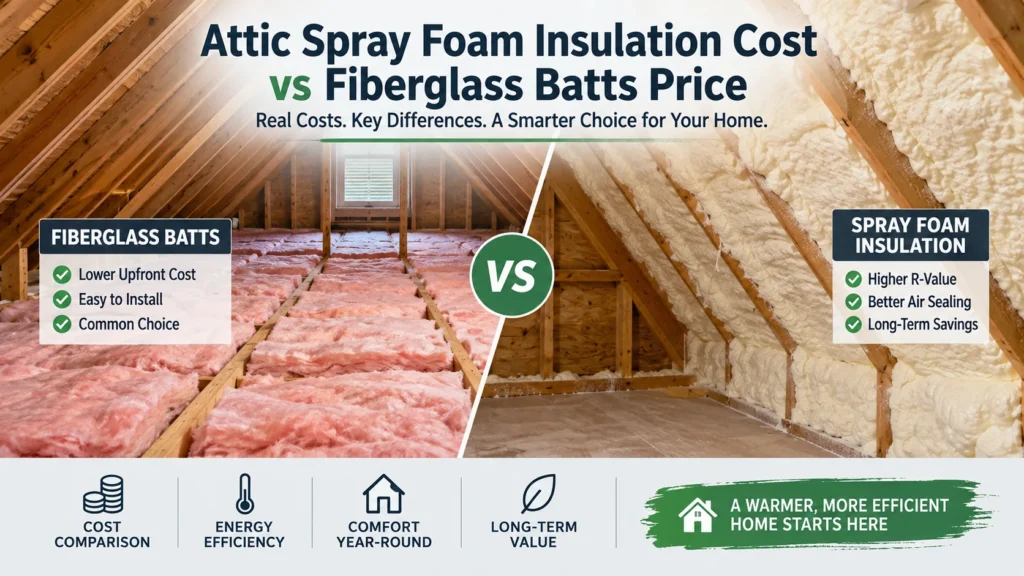
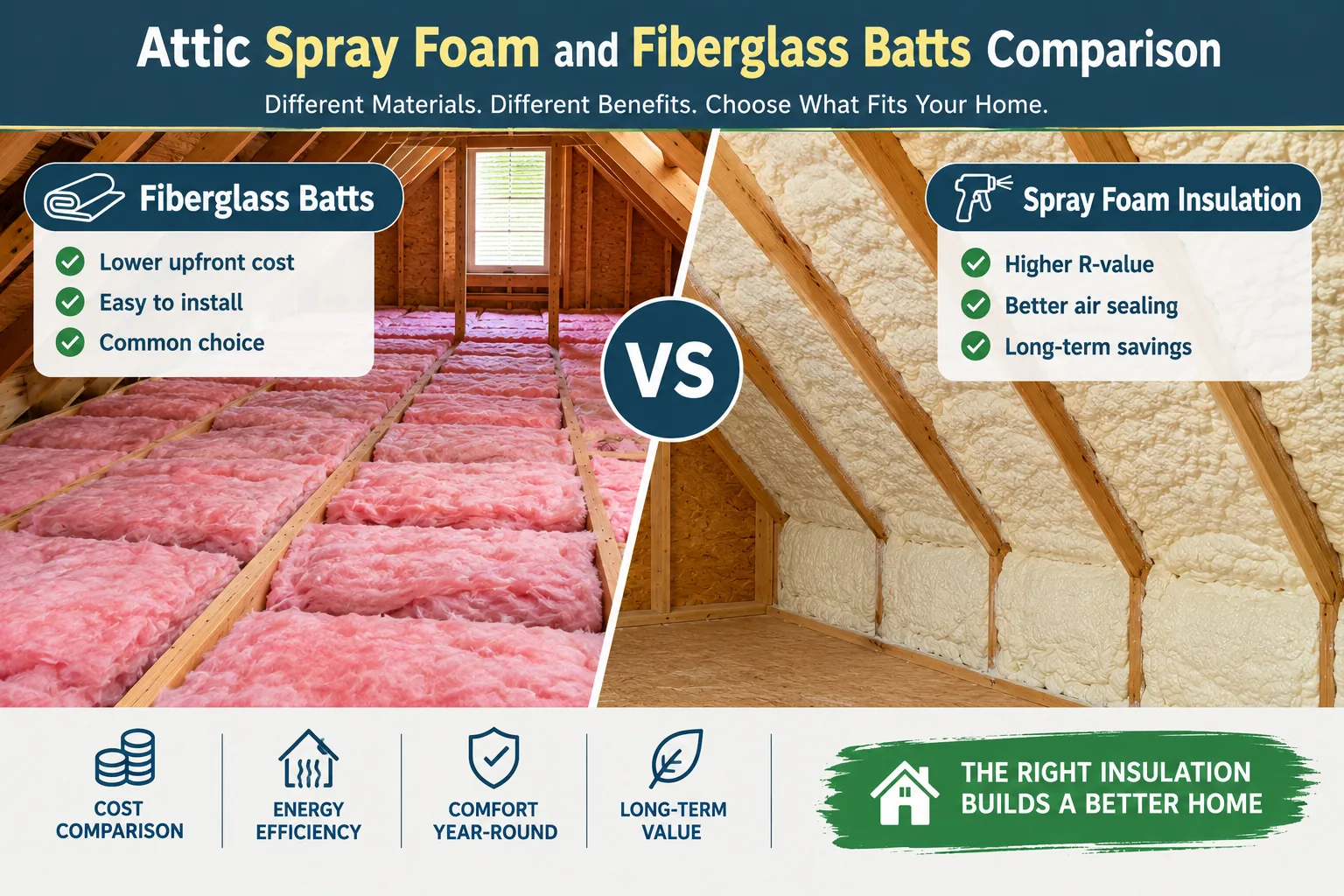
Image disclosure: Images are AI-generated illustrations, not photographs of FixingManual projects or hands-on product tests.
A hot upstairs bedroom can make an insulation upgrade feel urgent. Then the estimates arrive: one contractor recommends fiberglass on the attic floor, while another proposes spray foam under the roof. The attic spray foam insulation cost difference can be substantial, but those proposals may solve different problems.
Fiberglass batts generally have the lower upfront installation price.
HomeGuide lists fiberglass batts at about $1.00–$2.60 per square foot
installed and spray foam at $1.50–$5.00. These broad benchmarks do not
establish equal insulation performance or include every attic
preparation expense. Thickness, coverage area, and the proposed attic
design matter just as much as the material. [1]
Here is how to compare attic spray foam insulation cost vs fiberglass
batts price without overlooking the work that makes either option
effective.
What Does Attic Spray Foam Insulation Cost?
Use these national guide figures to compare attic spray foam insulation cost and begin a conversation with local attic insulation contractors. They are planning ranges, not a quote for your address.
| Insulation option | Installed price benchmark | What to clarify |
|---|---|---|
| Fiberglass batts | $1.00–$2.60 per square foot | Product R-value, layers, and separate air sealing |
| Open-cell spray foam | $1.50–$3.50 per square foot | Specified thickness and moisture-control requirements |
| Closed-cell spray foam | $3.00–$5.00 per square foot | Specified thickness and full assembly design |
The figures above come from HomeGuide’s spray foam comparison. Its
separate batt-and-roll guide lists R-38 batts at $1.10–$3.30 per square
foot installed, illustrating why a general material average can differ
from a specific R-value quote. Neither table guarantees a code-compliant
attic at its lowest price. [1][2]
For a hypothetical 1,000-square-foot surface, a $2.00 fiberglass rate
produces a $2,000 insulation line item. A $4.00 foam rate produces
$4,000. That arithmetic is useful only after you confirm the covered
surface, insulation specification, and exclusions. It is not a
prediction of your complete project cost.
Compare the
Attic Floor with the Roofline First
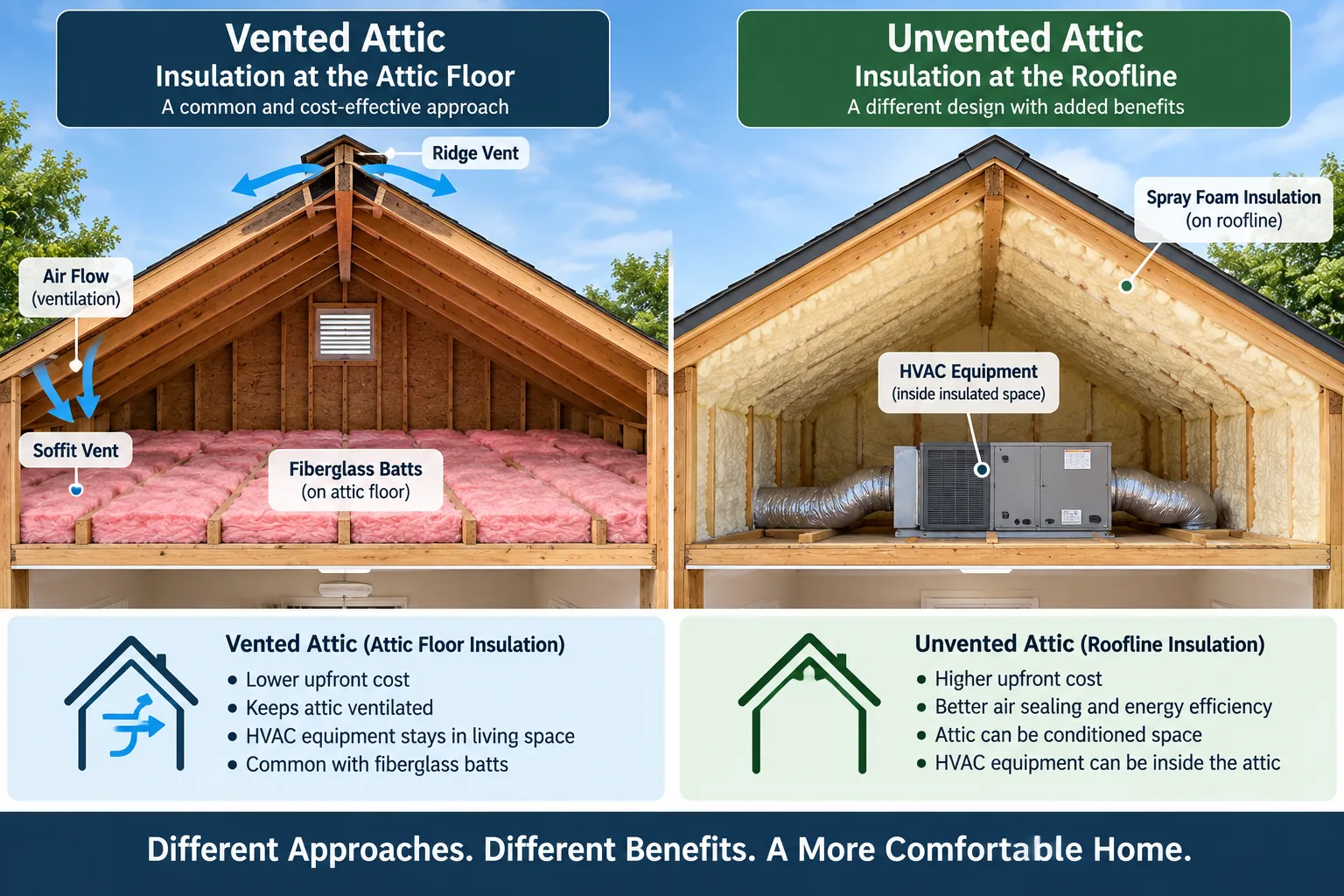
In a conventional vented attic, insulation usually follows the floor
above the living space. A roofline project moves the insulated enclosure
upward and can bring attic HVAC equipment within that enclosure. Complex
ceiling shapes can also make a roofline approach worth evaluating. These
are different building designs, not simply competing insulation
products. [3]
Ask each bidder to mark the proposed insulation location on a photo
or sketch. Does the price cover the flat floor, sloped roof surfaces,
gable walls, or a combination? Sloped roof area can exceed the floor
footprint, and additional wall coverage widens the difference.
For example, compare a fictional 1,000-square-foot floor proposal
with a 1,400-square-foot roof-and-gable proposal. At assumed rates of $2
and $4 respectively, their insulation line items are $2,000 and $5,600.
The $3,600 difference includes both a higher rate and more surface area.
Calling it only a “foam premium” would hide part of the explanation.
Understand Square
Feet, Board Feet, and R-Value
Square feet measure coverage. Board feet measure volume: one board
foot equals one square foot covered one inch thick. A hypothetical
1,000-square-foot surface sprayed three inches thick requires 3,000
board feet before any allowance for waste or surface variation.
A quote of $1 per board foot therefore does not mean $1 per square
foot at every thickness. Have the contractor translate the proposal into
total dollars, installed depth, and covered area.
R-value describes resistance to heat flow. ENERGY STAR explains that
higher R-values indicate greater thermal resistance. Ask for the
proposed final R-value appropriate to your location and project, rather
than treating equal inches of different materials as equal insulation.
[4]
Keep these three measurements together on your comparison sheet. A
low rate with an unspecified depth is not enough information to make a
purchase decision.
Fiberglass
Batts: A Practical Budget Starting Point
Fiberglass batts deserve a quote when the attic floor is accessible
and the aim is to improve insulation above existing rooms. Their
purchase price is easier to compare when each contractor names the same
product, coverage, and R-value.
Air sealing must be part of the conversation. ENERGY STAR recommends
sealing attic floor leaks before adding insulation and addressing the
attic hatch. Adding insulation alone does not complete that work. [4]
Ask whether the crew will photograph the floor after sealing and
before covering it. This gives you a useful record of work that becomes
difficult to inspect later. Request separate pricing for the insulation
and preparation so you know where the money goes.
Batts are also worth comparing with a blown-in alternative if the
floor has many awkward spaces. ENERGY STAR lists loose-fill insulation
among the options suited to unfinished attic floors and hard-to-reach
locations. A third quote can reveal whether the original two choices are
unnecessarily limiting your options. [4]
Spray Foam:
What the Higher Price Should Include
Spray foam can be useful when the project calls for an insulated
roofline and a carefully designed unvented attic. But “spray the roof”
is an incomplete scope.
PNNL’s Building America guidance calls for moisture removal through
an appropriate conditioning, dehumidification, or controlled ventilation
strategy. Foam alone does not automatically create a properly
conditioned attic. The design must also account for combustion equipment
and the home’s ventilation needs. [5]
Open-cell versus closed-cell
foam
Open-cell foam is vapor permeable; closed-cell foam can provide vapor
control as part of a suitable assembly. Climate, product properties, and
installed thickness affect the design. PNNL also identifies
product-specific or code-related ignition and thermal barrier
requirements. Ask which requirements apply to your proposed installation
and whether their cost is included. [5]
The useful question is not which foam sounds more advanced. It is why
the selected product fits your roof assembly, available depth, and
moisture conditions. Have the installer put that explanation in
writing.
Expenses That Can
Change the Final Quote
An attic insulation estimate should make the following costs visible
rather than burying them in a single square-foot rate.
Existing insulation and
repairs
Do not assume every upgrade requires complete removal. Ask what can
remain and what needs to come out, with photographs explaining the
recommendation. Wet insulation, roof leaks, and damaged framing should
be assessed before the new work proceeds. ENERGY STAR identifies these
as problems to address with professional help. [4]
Access and project
protection
A narrow hatch, stored belongings, and limited working room can
change the crew’s plan. Ask who clears the attic, protects the route
through the house, and restores any opening enlarged for access. Include
disposal and final cleaning in the written scope.
Foam installation
arrangements
EPA’s archived safety guidance states that safe re-entry timing
depends on the formulation and conditions affecting curing. Obtain
written, product-specific instructions for occupants and pets, including
ventilation and reoccupancy arrangements. Do not assume every
installation has the same 24-hour schedule. Account for temporary
accommodation if your installation plan requires it. [6]
Inspection and documentation
Ask whether permits, required inspections, product records, and
completion photos are included. For foam, request documented thickness
checks; PNNL recommends checking for consistent specified depth and
gaps. [3]
A Sample Budget Comparison
The following numbers are deliberately hypothetical allowances, not
national averages. They show how to organize bids after the insulation
location and performance targets have been established.
| Sample budget item | Fiberglass floor project | Spray foam roofline project |
|---|---|---|
| Insulation installation | $2,200 | $5,600 |
| Preparation and related work | $800 | $1,400 |
| Quoted project subtotal | $3,000 | $7,000 |
| Homeowner reserve of 10% | $300 | $700 |
| Planning budget | $3,300 | $7,700 |
These examples describe different scopes and do not imply equal
performance. Replace every figure with local written estimates. Obtain
separate prices for any unresolved roof repairs, mechanical changes, or
required protective coverings before treating the budget as
complete.
A reserve can help with modest surprises. It should not replace an
investigation when there is already evidence of a significant
problem.
Is Spray Foam Worth the
Extra Money?
Before accepting an attic spray foam insulation cost estimate, begin with the problem you want to solve. Is the upstairs uncomfortable? Are the ducts in the attic? Is the existing insulation shallow, or is the main concern air leakage? An energy assessment can help shape the scope before you choose a product.
Then compare attic spray foam insulation cost with a credible estimate of additional savings. Suppose a complete foam proposal costs $4,000 more than a complete fiberglass-and-air-sealing proposal. If an assessment estimates that foam would save an additional $200 annually, the simple payback on that premium is 20 years: $4,000 divided by $200.
That is a hypothetical calculation, not an expected result. It
excludes financing, maintenance, energy-price changes, and the value of
comfort. Savings credited to the foam option must be additional to the
savings already expected from the fiberglass project. Using all
projected savings to justify only the price difference would overstate
its value.
Questions to Ask
Attic Insulation Contractors
To evaluate attic spray foam insulation cost, request written answers from two or three contractors:
Which surfaces are included, and how were they measured?
What product, installed thickness, and final R-value are
specified?Which air-sealing and preparation tasks are included?
What ventilation, moisture-control, or mechanical changes are
needed?Are permits, protective barriers, cleanup, and inspections
included?What documentation will verify installation quality?
What does the workmanship warranty cover, and who handles a
defect?
Compare attic spray foam insulation cost and completed project totals before considering insulation financing. A lower monthly payment can still represent a higher total purchase cost. Also ask your utility about available insulation rebates and confirm eligibility before scheduling; program availability and application timing need local verification.
Related homeowner guide: Before insulating below the roofline, check the roof system for moisture entry using our emergency roof repair cost guide.
Ask Both Insulation Bidders to Price the Same Boundary
Have each contractor mark the area being insulated and explain whether the proposal keeps the attic vented or changes the enclosure. Request the required air-sealing, ventilation, equipment, and safety work alongside the insulation price. A price per floor square foot is not directly comparable with a roofline or board-foot quote. If comfort remains the concern, review the design questions in our HVAC installation guide.
Frequently Asked Questions
Is fiberglass always cheaper than spray foam?
Its basic installed price is generally lower, but extensive
preparation can change the total. Compare equivalent project
specifications where possible and identify differences where the
proposed attic designs are different.
Can I compare a material-only price with a contractor quote?
Only after adding the missing labor and project expenses. Store
packaging also covers a specific area at a stated thickness, so compare
coverage and R-value alongside the package price.
Should I choose the lowest insulation estimate?
Choose a documented scope you understand. An estimate missing
thickness, preparation, or required additional work may look cheaper
because it leaves important expenses unresolved.
Will better insulation guarantee a cooler upstairs?
No single product guarantees that outcome. Ask the assessor to
investigate the rooms, ducts, insulation, and air leakage so the
proposal addresses the actual complaint.
Which Option Fits Your Attic?
For a budget-focused attic floor upgrade, start with a complete fiberglass-and-air-sealing estimate. If attic equipment or the building layout makes a roofline project attractive, get a fully specified spray foam proposal as well. Compare the attic spray foam insulation cost only after choosing the design that addresses your home’s needs, and compare measured areas, installation quality, and complete costs before signing.
Sources
[1]
HomeGuide spray foam insulation cost
[2]
HomeGuide batt and roll insulation cost
[3]
PNNL unvented attic insulation
[4]
ENERGY STAR attic sealing and insulation
Keep reading
Related Articles
Home Systems & Energy
Aluminum Wiring Pigtail Repair Cost for an Older Home
Home Systems & Energy