
Home Systems & Energy
Generator Interlock Kit Installation Cost for a Portable Generator
Compare generator interlock quotes, panel and generator compatibility, inlet and cord scope, priority loads, permits and outdoor placement requirements.
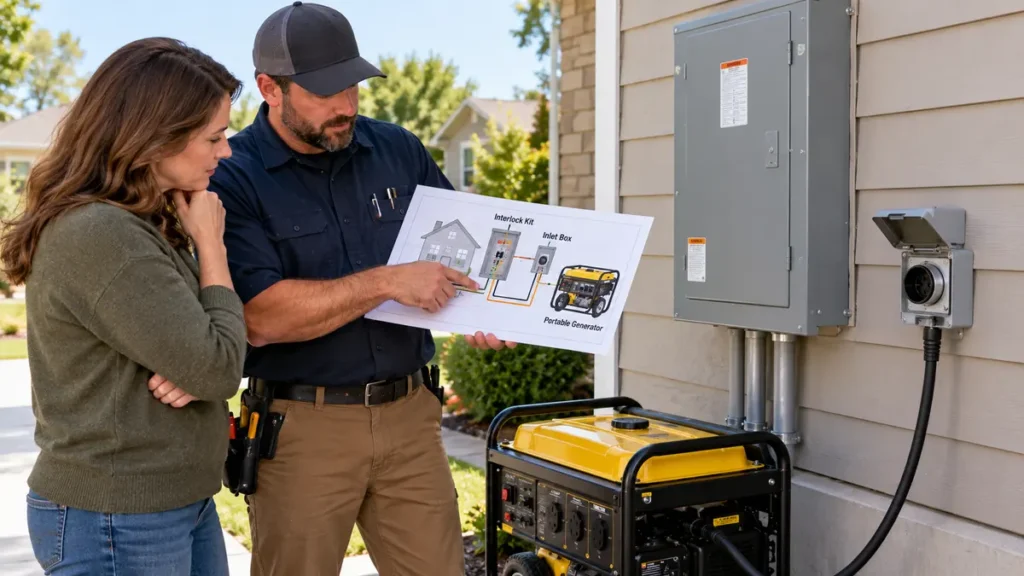
Generator interlock kit installation cost covers part of a portable generator backup plan, not the generator itself. A suitable arrangement must prevent utility and generator sources from being connected together. Have a qualified electrician assess the panel and generator before choosing the connection equipment.
Published US estimates commonly place generator interlock kit installation cost around $400 to $850 for labor and materials. [1] The portable generator itself is a separate purchase. A longer inlet wiring route, panel changes, permit requirements, or incompatible equipment can increase the project's total or lead the electrician to recommend a different connection arrangement.
Generator Interlock Kit Installation Cost: Published Breakdown
HomeGuide provides the following general estimates. The installed total is a project reference, not a guarantee that every listed accessory is included in every contractor's offer. [1]
| Cost category | Published planning range |
|---|---|
| Interlock kit | $50 to $150 |
| Job supplies such as inlet breaker and cord | $200 to $400 |
| Installation labor | $150 to $300 |
| Installed project total | $400 to $850 |
The total is not an additional charge to add to the other rows. Ask your electrician which components and labor the quoted price includes. In particular, confirm whether the generator cord and inlet are supplied or left for you to purchase.
Avoid assuming the installation price provides whole home backup capability. The generator's output and the selected loads determine what can operate. An interlock arrangement does not increase generator capacity or remove the need to manage demand.
Confirm That an Interlock Suits the Panel
Have the electrician identify the exact panel and proposed interlock before ordering equipment. Schneider Electric describes interlock kits for its specified load centers and breaker arrangements. [2] Similar appearance does not establish compatibility with your equipment.
Ask whether the proposed assembly is approved for the panel and acceptable to the local inspection authority. Have the exact kit identified in the quote. The contractor should explain any required panel changes rather than assuming a generic online plate provides the right solution.
Do not remove the panel cover to measure or modify components yourself. Share existing records and let the electrician assess the equipment. If compatibility is uncertain, request a clear alternative estimate rather than forcing the installation around a kit you already bought.
What the Interlock Is Intended to Do
A suitable mechanical interlock arrangement prevents the utility main and generator supply breakers from being on together. Schneider Electric's equipment documentation describes this interlocking relationship. [2] Proper installation and the complete electrical arrangement still matter.
An interlock is not an automatic starting system. Ask the installer how the selected setup is used, who can operate it, and which written instructions will be supplied. A portable generator still requires the operator to follow its manufacturer guidance and the electrician's approved plan. For a separate automatic backup project, see the whole-house generator installation cost guide.
Never connect a generator to home wiring through an ordinary wall outlet or a makeshift cord. Do not depend on remembering to isolate utility power manually without an approved transfer arrangement. Have a qualified electrician design and install the connection.
Inlet Location and Cable Route Affect Price
A portable generator inlet electrician should discuss the generator's intended outdoor operating location before choosing the inlet position. A convenient spot beside the panel may not work with a safe generator placement or the required cord arrangement.
Ask how the inlet wiring will reach the panel and whether the route requires wall access, exterior work, or additional protection. Clarify whether patching and painting are included. A longer or more difficult route can make a basic advertised package unsuitable for your property.
The inlet, cord, generator outlet, and electrical arrangement must be compatible. Provide the generator model and manual rather than describing it only by its advertised wattage. Do not buy adapters to resolve a mismatch without the installer's assessment.
Generator Compatibility Includes More Than Output
Ask the electrician to assess the generator’s electrical configuration, protective features and capacity. Neutral and grounding arrangements affect transfer equipment selection. Reliance Controls publishes dedicated neutral-switching transfer panel information, illustrating why equipment choice requires more than a wattage comparison. [4]
Do not alter the generator's bonding or protective devices yourself to make it operate with a proposed connection. The professional assessment should determine the appropriate arrangement using the equipment instructions and local requirements.
If you have not purchased a generator, ask which specifications the connection plan requires before ordering one. If you already own one, obtain confirmation that the estimate is designed for that exact equipment. That can prevent paying for an installation that later requires a different machine or transfer setup.
Choose the Loads You Actually Need
List the household functions that matter during an outage. Refrigeration, lighting, communications, and selected heating equipment may be priorities, but each must be evaluated for running demand and startup requirements.
Ask the electrician to distinguish essential loads from optional conveniences. Equipment connected to the panel is not automatically suitable to run simultaneously on the generator. A written load plan helps the operator avoid guessing during an outage.
Discuss any equipment that cannot tolerate an interruption. A portable generator setup requires human action and does not guarantee seamless power. Separate backup arrangements may be needed for specific equipment, and those should have their own assessment and budget. Our battery backup sump pump guide covers a separate pump-backup decision.
Interlock Versus Manual Transfer Switch
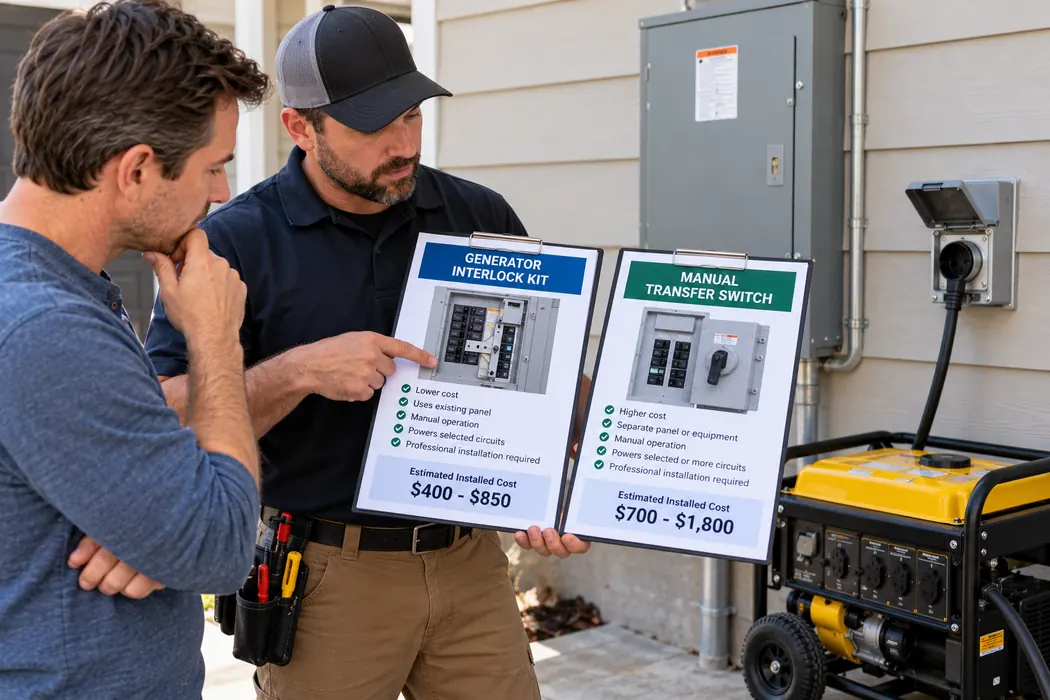
HomeGuide lists roughly $400 to $1,300 for a manual transfer switch installation, compared with $400 to $850 for an interlock installation. [1] Those ranges overlap and do not establish which option is best for your panel or household.
Ask how each proposal selects and controls loads. Discuss ease of operation, available space, generator compatibility, and inspection requirements. A less expensive option may not provide the arrangement you need, while a more expensive one should have a clear practical reason.
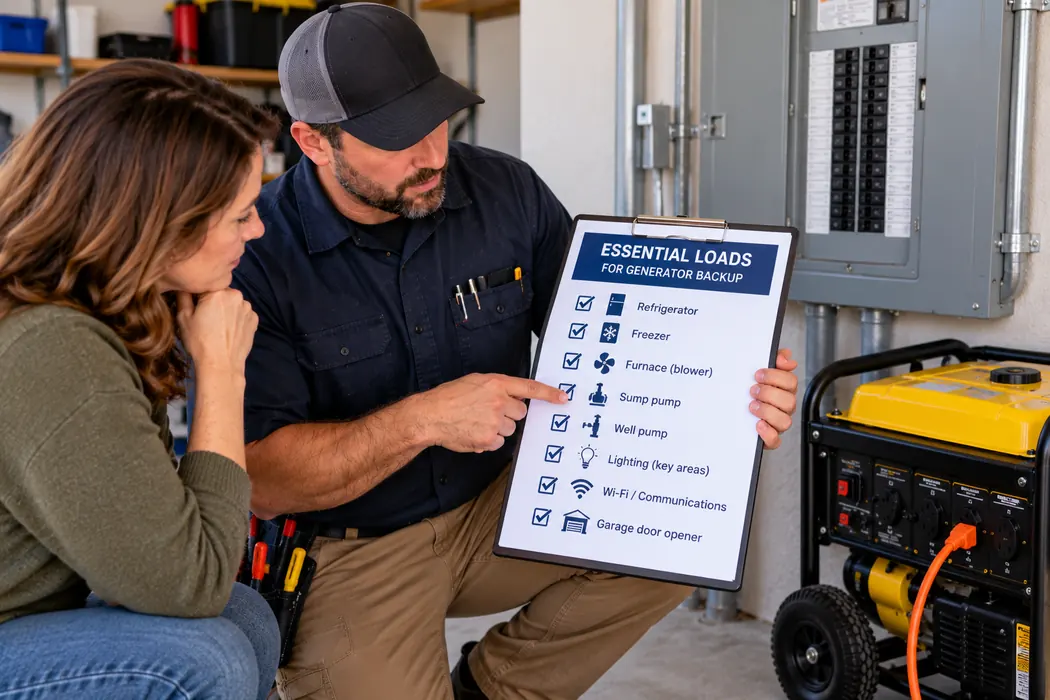
Obtain separate complete prices when both options are feasible. Compare the inlet, cord, wiring route, permit handling, and demonstration as well as the transfer equipment. Otherwise, the price difference may reflect different accessories rather than different connection methods.
Outdoor Generator Safety Is Part of the Plan
CPSC says to operate portable generators outdoors only, at least 20 feet from the home, with exhaust directed away from nearby buildings. Never run one inside a home, garage, basement or shed. Keep working CO alarms as part of the household safety plan. [3]
Discuss how your property can accommodate that placement while meeting the generator's instructions. Do not use the inlet location as a reason to operate the generator in a garage, beside an open window, or in an enclosed area.
If a CO alarm sounds or poisoning is suspected, get outside to fresh air and call 911. [3] An interlock prevents neither exhaust exposure nor every misuse of the generator. Electrical connection and safe outdoor operation are both necessary parts of the project.
What a Complete Quote and Handover Include
Request the interlock model, inlet, compatible breaker arrangement, cord scope, wiring route, permits, and required inspection in writing. Ask how unforeseen panel conditions will be handled and whether any finish repairs are excluded.
Have the installer provide labels, equipment records, and operating instructions specific to the completed arrangement. Request a demonstration with the intended generator. The person expected to operate it should understand the plan before an actual outage occurs.
Keep the generator manual and installation documents together. Follow the manufacturer's maintenance instructions and ask the installer about an appropriate readiness check. Equipment that has sat unused should not be assumed ready solely because the connection was installed correctly months earlier.
7 Practical Checks Before Accepting a Generator Connection Quote
1. Bring the exact generator information
Give each electrician the model number and manufacturer manual for the generator you intend to use. If you have not selected one, explain the functions you want to support and ask which specifications must be resolved first. A similar-looking generator may have a different electrical arrangement, so the quote should not rely on appearance alone.
A generator interlock kit installation cost estimate should identify what equipment was assessed. Ask the installer to list any decisions still pending and avoid buying cords or adapters before that review. If the generator changes after the quote, have the electrician confirm whether the original arrangement remains suitable.
2. Have the panel assessed professionally
Share existing panel records if you have them, and let the electrician identify the equipment on site. Ask which interlock is proposed and how compatibility and local acceptance will be confirmed. Request a clear description of any panel change included in the price, with a separate explanation for work outside the connection project.
Compare generator interlock kit installation cost only after the proposed arrangement is defined. If one contractor recommends a transfer switch instead, ask what condition supports that recommendation. Do not assume the cheapest plate available online can be substituted for the equipment the professional has specified.
3. Connect the inlet plan to outdoor placement
Show the electrician the outdoor areas available for generator use and discuss doors, windows and nearby buildings. Ask how a safe operating location affects the inlet and cord arrangement. Resolve that question before selecting an inlet simply because it is close to the panel. Never use a garage as an operating location.
A generator interlock kit installation cost quote should state the proposed inlet location and the wiring route priced. If the location changes to support a suitable outdoor plan, request a revised scope. Do not use the close-to-house placement in the illustrations as an example to copy during an outage.
4. List the loads in priority order
Tell the electrician which household functions matter most and what can wait during an outage. Include equipment that starts intermittently and anything for which an interruption would be a serious problem. Ask what information from the actual equipment is needed rather than assigning demand from an illustrative checklist.
Separate the generator interlock kit installation cost from any additional backup equipment proposed for a particular need. Ask the installer to explain the intended limits in writing. Access to circuits on the panel is not a promise that every connected appliance can operate together on a portable generator.
5. Check every item in the quote
Ask whether the price includes the inlet, the specified cord, wiring, panel components, labels and a demonstration. Mark finish repairs and any additional electrical work as included or excluded. For an allowance, ask what quantity or route it assumes and what would trigger a revised price.
Compare generator interlock kit installation cost with transfer switch proposals on the same complete scope. If one offer includes a cord and another does not, request the missing price before comparing totals. Do not add the published component ranges to a contractor package that already includes those items.
6. Agree on approvals and scheduling
Ask who arranges required permits and inspections and whether their fees and return visits are included. Confirm the planned power interruption so you can protect ongoing work and arrange around household needs. If the inspection sequence changes the completion date, ask how the company communicates that and what remains unfinished.
Before accepting generator interlock kit installation cost, clarify how concealed conditions or incompatible equipment will be documented. Request a written change description and price before approving extra work. If a different transfer arrangement is needed, have the contractor explain the revised design and the complete cost separately.
7. Make the handover useful to the operator
Ask the installer to provide instructions for the completed arrangement and demonstrate it with the intended generator in an appropriate setting. The person expected to use it should know where to find the documents and whom to contact with questions. Have the electrician explain the limits without relying on generic steps from a website.
Reconcile the final generator interlock kit installation cost against the accepted estimate and approved changes. Keep the generator manual, installation records and inspection paperwork together. Ask what readiness checks and maintenance the manufacturer requires.
Compare Generator Interlock Kit Installation Cost for the Complete Plan
List the generator purchase, installation, accessories and other backup needs separately. Record each supplier and price. Mark unresolved costs as pending rather than zero.
A useful generator interlock kit installation cost comparison connects the household priorities with a suitable electrical arrangement and outdoor operating plan. If those cannot be met at the proposed location, ask for an alternative before ordering equipment. A low connection price does not compensate for an unsuitable generator or an unsafe operating position.
Keep options distinct when requesting revised quotes. One may use the existing panel with compatible equipment while another uses a separate transfer arrangement. Ask each bidder to explain what the operator will need to manage, what equipment is included and what remains outside the installation. Compare those differences alongside the totals.
Keep Optional Work Separate
Ask the electrician to price unrelated improvements separately from the generator connection. An extra receptacle, a service upgrade or a different backup system may be useful, but its purpose and price should be clear. If an option changes the proposed connection or the equipment needed, request an updated specification before accepting it.
Review generator interlock kit installation cost alongside the actual operating plan. Confirm that the person who will use the generator can understand the installer’s instructions and has access to the records. If your priorities change, such as adding equipment that needs dependable uninterrupted power, seek a new assessment rather than assuming the original portable backup plan provides that coverage.
Resolve Open Questions Before Ordering
If the first estimate depends on a panel assessment or a generator you have not selected, ask which price is firm and which part is provisional. Keep the model information and the electrician’s written recommendation together. Have any substitute reviewed before purchasing it rather than assuming an identical connector makes the equipment interchangeable.
Request a revised generator interlock kit installation cost total when those decisions are resolved. Confirm the intended outdoor location, accessory scope and inspection responsibilities again if the equipment changes. The accepted quote should describe the installation the contractor will actually complete, with unresolved items clearly identified instead of hidden in a general allowance.
\n
Frequently Asked Questions
Can every main panel accept a generator interlock?
No. The exact panel, breaker arrangement, listed kit and local inspection authority all matter. A generic plate that looks similar online is not proof of compatibility. Ask the electrician to identify the panel model and proposed kit in the written quote.
Is an interlock kit safer than plugging a generator into a wall outlet?
An approved interlock arrangement is designed to prevent the utility main and generator breaker from being on together. Plugging a generator into a wall or dryer outlet is not an acceptable substitute and can backfeed dangerous power into utility lines. Have the entire connection installed by a qualified electrician.
Does the installation quote include the generator?
Usually no. The generator, inlet box, cord, breaker, wiring, permit and labor may be separate line items. Ask the contractor to mark each item as included, excluded or allowance so you know the true project budget.
Will an interlock run every appliance in the house?
No. The generator’s running and starting capacity, the selected loads and the operator’s load-management plan determine what can run. A panel interlock does not increase generator output or make every circuit suitable to operate at once.
Does an interlock eliminate the need for a permit?
Not necessarily. Permit and inspection requirements vary by state, city and authority having jurisdiction. Ask who will obtain the electrical permit and whether the quoted price includes inspection-related return visits.
Should I choose an interlock or a manual transfer switch?
Compare the complete scope rather than the equipment name. An interlock may cost less and can provide access to selected panel circuits, while a manual transfer switch may offer clearer circuit selection or suit a panel where an approved interlock is unavailable. The electrician should explain the reason for the recommendation.
Can I operate the generator in my garage if the inlet is outside?
No. The electrical inlet does not make generator exhaust safe. CPSC recommends operating portable generators outdoors at least 20 feet from the home, away from doors, windows and vents, with exhaust directed away. Keep working carbon-monoxide alarms in the home.
What should I do if the quoted price changes after work starts?
Ask for the cause, affected item, quantity and revised price in writing before approving additional work. Hidden panel damage, a longer wiring route, incompatible breakers or permit requirements should not be buried in a vague allowance.
Sources
- HomeGuide: Transfer switch and interlock installation costs
- Schneider Electric: Interlock equipment function and specified compatibility
- CPSC: Portable generator and carbon monoxide safety
- Reliance Controls: Neutral-switching transfer panel information
Sources checked November 4, 2026. Homeowner quote guidance, not electrical installation or operating instructions. Images illustrate planning discussions; nearby or indoor generators shown must not be operated in those positions.
Keep reading
Related Articles
Home Systems & Energy
Sewer Camera Inspection Cost Before Buying an Older House
Home Systems & Energy