
Interiors & Remodeling
Sill Plate Replacement Cost When Rot Is Found Under Exterior Walls
Learn sill plate replacement cost by linear foot, when rot requires structural support, how water and termites cause damage, and how to compare complete repair quotes.
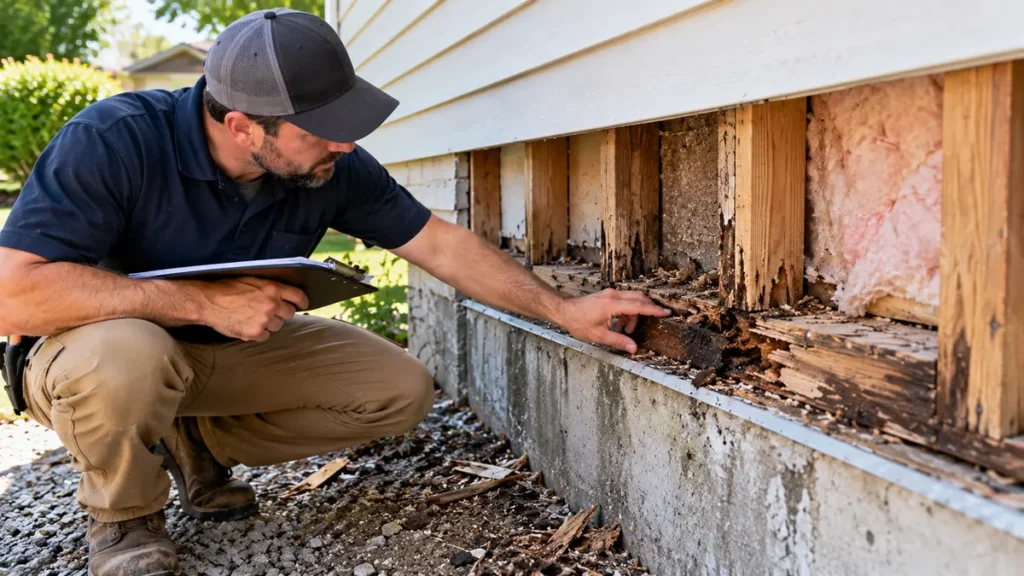
Rotted sill plate replacement cost is high expensive mainly because of the structure resting above the wood. The contractor may need to provide temporary support, open the wall or floor edge, replace damaged framing, and restore the assembly. Buying a new board is a small part of that job.
HomeGuide publishes a planning range of $120 to $200 per linear foot for sill plate replacement. The actual price depends on access, damage, labor, and the required support work. A small isolated repair can also carry setup costs that make a simple per-foot calculation unreliable. [1]
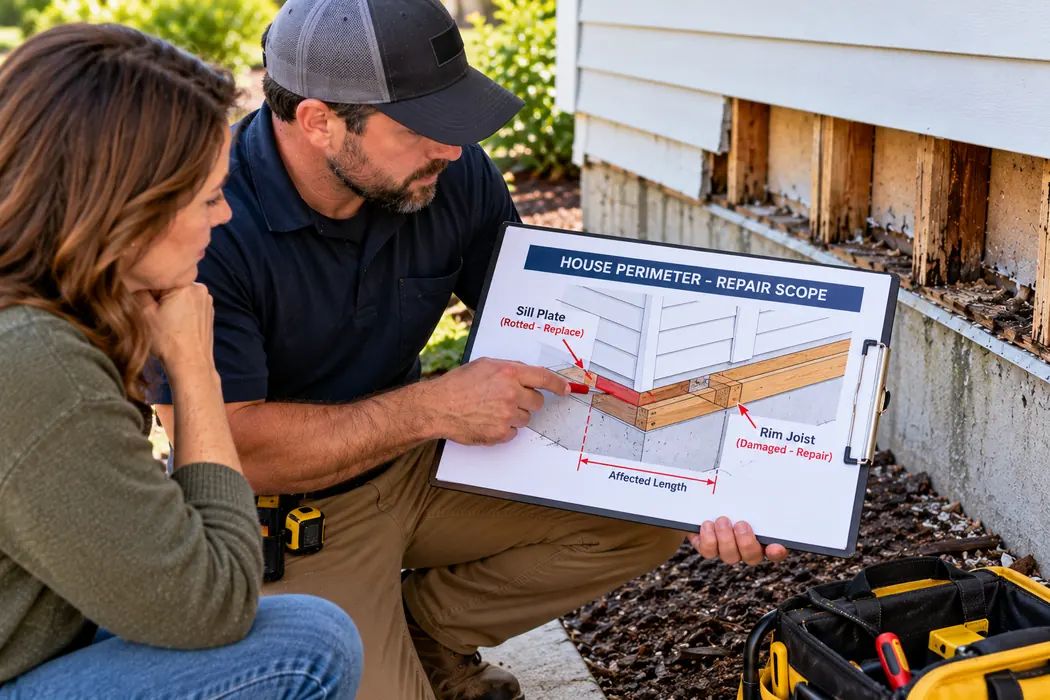
Before using that range, confirm that the sill plate is the damaged component. Rim joists, joist ends, wall framing, and other nearby wood may also need repair. A useful rotted sill plate replacement cost estimate identifies each component separately.
Know which piece of wood needs replacement
In many wood-framed houses, the sill plate sits at the top of the foundation and forms part of the connection to the structure above. The rim joist closes the perimeter of the floor framing. These members are close together but serve different functions.
Ask the inspector to label photographs of the damage. If the contractor says the sill is rotten, request an explanation of what was exposed and what remains concealed. A stained exterior board or damp interior trim does not establish how much structural wood has deteriorated.
Have the repair length measured and recorded. The visible damaged area may be shorter than the affected wood behind siding, insulation, or finishes. The estimate should distinguish the confirmed length from areas that require further investigation.
Rotted Sill Plate Replacement Cost Per Foot: Starting Allowance
The following figures are arithmetic based on HomeGuide's $120 to $200 per linear foot range. They are planning examples for the stated length, not promises that a local contractor will accept the job at that price. [1]
| Repair length | Starting calculation before scope adjustments |
|---|---|
| Ten linear feet | $1,200 to $2,000 |
| Twenty five linear feet | $3,000 to $5,000 |
| Fifty linear feet | $6,000 to $10,000 |
| One hundred linear feet | $12,000 to $20,000 |
For a short section, ask about mobilization and minimum charges. For a long section, ask whether the price includes every opening, temporary support area, and finished surface affected by the work.
Sill Plate Replacement Cost Estimator
Use this calculator as a transparent starting allowance based on the published $120–$200 per linear foot planning range. It does not diagnose the structure or replace an engineered quote. Add separately documented costs for engineering, permits, temporary support, water correction, pest treatment, finish restoration, or concealed framing.
Estimated planning range: $3,000–$5,000
Formula: linear feet × $120–$200 + documented extras. The range is a planning allowance, not a local bid; small jobs may have minimum charges, while structural damage can require a much larger scope.
Price comparisons only make sense when the repair lengths and assemblies match. A quote covering ten feet of sill alone is not equivalent to one covering the sill, rim joist, and several damaged joist ends.
Temporary support is part of the repair design
Replacing wood beneath an exterior wall requires a plan for carrying the affected load while work proceeds. Ask who prepares that plan and whether an engineer is involved for your particular house and damage.
The proposal should explain the intended result and support responsibility without expecting you to direct the lifting work. Discuss whether limited movement is required and how the crew will protect nearby finishes and connected services.
Do not remove rotten structural wood or try to lift the house with retail jacks. If the wall or floor appears unstable, keep people clear and obtain urgent professional advice. A deteriorated load path can be unsafe even when the visible repair length seems small.
Hidden damage can expand the project
Rim joist repair may be discovered when access is opened. Joist ends, sheathing, insulation, or wall framing can also be affected by the same moisture source. Ask the contractor how these components will be inspected.
Before signing, agree on the change-order process. Newly exposed damage should be photographed, described, and priced before the added work is authorized, except where an immediate safety response is necessary. Discuss how the contractor handles that exception.
Ask whether the estimate includes an allowance or a fixed scope for concealed work. An allowance should have a defined purpose and a way to reconcile the final cost. Avoid a contract that allows unspecified extras without explaining how they are calculated.
Correct the moisture path before closing the wall
Replacing damaged wood without addressing the moisture source leaves the new work exposed to a similar problem. Ask whether water is entering from exterior flashing, plumbing, ground contact, or moisture moving from the foundation.
The Department of Energy explains that moisture can move through bulk water, capillary action, air, and vapor. Its building-science guidance describes a protective membrane between the foundation and sill plate as a capillary break that reduces water wicking into the wood. [2]
The right details depend on your wall assembly and local requirements. Ask the structural wood repair contractor how flashing, drainage, the foundation-to-wood interface, and air sealing will be restored. Have the relevant trade review the source of the moisture if it falls outside the contractor's expertise.
Pest damage and moisture damage need separate attention
Ask whether the inspection found evidence of insects as well as decay. If pest activity is suspected, arrange an assessment by an appropriately qualified pest professional. Replacing the board does not establish that an infestation has ended.
Coordinate structural repair with any treatment and inspection requirements. Ask how the finished assembly maintains access for future inspection where needed. Do not cover evidence of damage before it has been documented.
Keep pest reports and treatment records with the repair documents. They may help explain why the damage occurred and what steps were taken beyond replacing the wood.
Check what restoration the quote includes
Opening the house can involve removing siding, masonry veneer details, flooring, drywall, insulation, or trim. Ask which surfaces will be restored and whether matching materials are available. A structurally completed repair can still leave considerable finish work. For a separate exterior finish comparison, see our siding damage repair cost guide.
Include utility coordination when pipes, wiring, or ducts pass through the repair area. Ask who disconnects, protects, and restores those services if required. Make responsibility clear so it does not become a scheduling problem after the structure is temporarily supported.
Confirm cleanup, waste removal, and weather protection. An exterior opening needs a defined plan if the job is interrupted by rain or an unexpected material delay. Ask who checks that the home is secured at the end of each workday.

Choose a contractor for the full assembly
Look for relevant structural repair experience rather than general carpentry alone. Verify local licensing requirements and insurance. Ask for examples of similar completed repairs and how the company handled temporary support and concealed deterioration.
Confirm permit and inspection responsibility with the contractor and local building department. Request the specified replacement materials, fastening details, and any engineering documents that apply. Avoid substituting a product or connection without the responsible professional's approval.
Read the warranty to see whether it covers workmanship, materials, or a particular repair scope. Moisture recurrence, pest damage, and unrelated movement may be treated differently. Ask what maintenance or follow-up is required.
How to Tell Whether the Damage Is Structural
Soft or crumbling wood is evidence of deterioration, but the repair decision depends on what the plate supports and how far the damage extends. Look for related signs such as sticking doors, sloping floors, gaps at trim, wall movement, crushed wood, failed anchor locations, or decay in the rim joist and joist ends. These signs do not prove a cause by themselves, but they justify a professional structural assessment.
Do not confuse surface staining with confirmed loss of capacity, and do not assume a small visible hole means the damage stops there. FEMA guidance notes that sill decay can occur on the concealed back or bottom side. A qualified inspector may use probing or moisture measurements, but invasive testing and structural decisions should be coordinated with the responsible professional.
Water Rot and Termite Damage Need Different Solutions
Water can reach a sill through poor grading, clogged gutters, failed flashing, plumbing leaks, foundation seepage, crawl-space humidity, or a missing capillary break. Termites and other insects create a different problem. Ask for evidence supporting the suspected cause and arrange pest evaluation when there are mud tubes, frass, hollow-sounding wood, wings, or other activity.
Replacing the wood without correcting the water path or treating active pests leaves the new repair vulnerable. A complete proposal should identify which contractor handles drainage, flashing, plumbing, pest treatment, and structural replacement. Keep those scopes separate so a low structural price does not hide an unresolved cause.
Rim Joists, Joist Ends, and Studs May Also Be Damaged
The sill plate is only one part of the load path. Once the area is opened, the rim joist, floor-joist ends, wall studs, sheathing, insulation, anchor bolts, and sill sealer may need inspection. PNNL guidance recommends repairing dry rot or other damage before sealing the sill-to-foundation area and using a capillary break to limit moisture transfer.
Ask for a component-by-component scope and photographs before the assembly is closed. A proposal that says “replace sill” without describing adjacent framing may be incomplete, while a proposal that automatically replaces everything may be excessive. The right answer depends on observed condition and the structural design.
Temporary Shoring and Jacking Are Not DIY Shortcuts
Because the wall and floor loads may rest on the damaged plate, the repair can require temporary shoring, controlled lifting, or staged replacement. The support arrangement, lifting amount, sequence, and connection details must be designed for the building—not improvised from bottle jacks or scattered posts.
Keep occupants away from restricted areas and stop work if unexpected movement, cracking, utility strain, or instability appears. Ask who is responsible for the temporary-support plan and when a structural engineer is required. Online advice cannot determine safe support placement for your home.
Partial Repair Versus Full Replacement
| Approach | When it may fit | What to verify |
|---|---|---|
| Localized section repair | Damage is clearly bounded and sound wood remains at suitable connections | Load path, splice/connection design, anchor continuity, and moisture correction |
| Long-run or full replacement | Decay is widespread, the plate has lost continuity, or multiple adjacent members are affected | Temporary support, engineering, permits, finish restoration, and total project scope |
| Non-structural cosmetic repair | Only surface finish is damaged and the structural wood is confirmed sound | Independent inspection; filler or caulk must not conceal structural rot |
“Partial” does not automatically mean safe or inexpensive. A short structural repair can still require setup, access, engineering, and finish work. Compare the repair boundary and completion standard, not only the length of new lumber.
Permits, Engineering, and Local Code Depend on the Project
Permit and inspection requirements vary by jurisdiction and by whether the work changes structural framing, anchorage, exterior weather protection, or foundation connections. Ask the local building department and the contractor who will obtain permits, provide engineering documents, schedule inspections, and correct any inspection comments.
Do not treat a national cost guide or a contractor’s general statement as a permit determination. Your local authority may require a specific repair detail, engineered design, or inspection before the wall is closed. Put those responsibilities in the contract.
Compare Sill Plate Quotes by Completion Point
Two estimates may differ because one ends at replacement framing and the other includes weather barrier, siding, insulation, flooring, drywall, trim, paint, cleanup, and final inspection. Ask each bidder to mark included and excluded work. Also ask how concealed damage, weather delays, utility conflicts, and product substitutions will be handled.
Use the same photographs and measured length for each bidder, but allow each professional to inspect independently. A useful quote connects the evidence, temporary support, replacement materials, fastening, moisture correction, restoration, warranty, and total price.
Rotted Sill Plate Replacement Cost: 7 Easy Quote Checks
Use these checks to organize a professional assessment and compare proposals. They are questions for the responsible contractor, not instructions for removing structural wood or supporting a house.
1. Ask for a measured damage map
Have each bidder identify the same wall section and the components included in the proposed repair. Ask for the confirmed length to be marked on photographs or a simple location drawing. Record which surfaces were accessible during the inspection and which remain concealed. That distinction helps you understand whether an estimate is based on observed deterioration or an assumption about what will be found later.
A rotted sill plate replacement cost comparison should use matching quantities. If one company measures twenty feet and another measures thirty, ask both to explain their boundaries before comparing totals. Do not average the lengths or choose the shorter figure yourself. The contractor should explain where sound material and suitable connections can be established through professional assessment.
2. Separate the base scope from allowances
Request a written list of work included in the contract price. Keep any allowance for concealed framing clearly separate and ask what quantity, labor or materials it represents. Find out how unused allowance money is credited and how additional costs are documented. A low initial figure with an undefined allowance may leave more uncertainty than a higher price with a clearly described scope.
Ask how your rotted sill plate replacement cost would change if more deterioration is exposed. The contractor may be unable to give a fixed final total before opening the assembly, but can still explain the approval process. Agree on who receives photographs, who can authorize changes and what information accompanies a proposed adjustment. Keep those decisions with the original proposal.
3. Confirm responsibility for structural planning
Ask who evaluates the affected load path and who decides whether engineering is needed. Request the name of the professional or company responsible for any required design and clarify whether their fee is included. A general statement that the crew has repaired similar houses does not tell you what assessment your particular structure will receive or who is accountable for the plan.
When reviewing rotted sill plate replacement cost, distinguish the assessment fee from the repair labor and temporary support scope. Discuss how the contractor will communicate unexpected movement or unsafe conditions. Homeowners should understand the proposed outcome and restrictions without directing support placement or lifting. Do not enter an area the crew has restricted while structural work is in progress.
4. Trace the water problem to a named repair
Ask the contractor to describe the suspected moisture source and the evidence behind that conclusion. A plumbing leak, an exterior flashing defect and moisture at the foundation interface involve different work. Identify which trade will correct the cause and whether that work must occur before replacement framing is enclosed. If further investigation is necessary, ask how it will be coordinated with the structural repair.
The rotted sill plate replacement cost should show whether moisture correction is included, separately priced or excluded. Ask what condition will be checked before the wall is closed and who records that check. Avoid accepting a vague promise to waterproof everything without an explanation of the affected assembly. Keep product information and photographs of concealed details for future maintenance and inspection.
5. Include access and finish restoration
Walk through the proposed access route with the contractor and identify the rooms or exterior areas affected. Ask what needs to be moved, protected or temporarily unavailable. Discuss pets, stored belongings and access for occupants. Confirm whether the price includes reinstalling insulation, closing openings and restoring the visible finishes, or whether another contractor will complete those tasks after structural work is approved.
Compare rotted sill plate replacement cost on the same completion point. A proposal ending with exposed replacement framing is different from one including siding, trim and paint. Ask about matching older materials and whether a larger area must be refinished for a consistent appearance. Document any exclusions so the remaining restoration can be scheduled and budgeted before work begins.
6. Resolve permits and inspection timing
Contact the local building department to confirm the requirements that apply to the proposed repair. Ask the contractor who obtains the permit, arranges inspections and supplies required documents. Clarify whether inspection fees and engineering are included in the written quote. The need for a particular permit or design depends on the project and jurisdiction; a generic online example cannot settle that decision.
A rotted sill plate replacement cost estimate should explain scheduling dependencies as well as price. Ask how inspection delays, material availability and weather could affect the opening and closing of the assembly. Confirm who communicates changes to the homeowner and how the house will be protected during an interruption. Keep inspection results rather than relying solely on a verbal statement that the repair passed.
7. Review the handover before final payment
Agree in advance on the records you will receive when the work is complete. Useful documents include the final measured scope, approved changes, photographs of work before it was covered, relevant inspection records and written warranty terms. Ask how each item will be delivered and whether there are maintenance instructions for the restored exterior or moisture-control details. Keep everything together for future reference.
Your final rotted sill plate replacement cost should reconcile the original scope, allowances and approved changes. Review any remaining finish work and agree on how it will be completed under the contract. Ask whom to contact if new staining, a leak or movement becomes visible. A clear handover makes it easier to distinguish a repair concern from a separate issue elsewhere in the house.
If the inspection identifies a different structural problem, request a separate explanation rather than combining unlike repairs into one per-foot figure. For example, our helical pier installation cost guide concerns foundation support, which is a different project from replacing decayed wood at the foundation interface.
Give bidders the same photographs and existing reports, but allow each professional to assess conditions independently. Ask for differences in the recommended work to be explained in writing. A useful comparison connects the evidence, the specified repair and the restoration included in the price. It does not depend on the lowest total alone.
Frequently asked questions
Is sill plate replacement the same as rim joist repair?
No. They are different framing components, though both may be included in one project. Ask the contractor to name and locate each repair in the estimate.
Can I wait until the exterior paint fails?
Visible paint condition is not a measure of structural capacity. Have confirmed rot assessed promptly, especially if you notice movement, sagging, or separation nearby.
Does pressure-treated wood eliminate moisture problems?
No. Material selection does not replace moisture control, suitable connections, or a sound repair design. Ask how the assembly is protected as well as which wood is specified.
What documents should the contractor provide?
Keep the scope drawing, before-and-after photographs, approved changes, permits, inspections, engineering details, and warranty. These records show what was repaired and make future evaluation easier.
Can I replace a short sill plate section myself?
Do not assume a short section is safe for DIY work. If the wall or floor is load-bearing, temporary support and connection design may be required. Obtain an assessment before removing structural wood.
Will a new sill plate stop the problem from returning?
Only if the moisture, drainage, flashing, plumbing, or pest cause is also corrected. The contract should identify the cause and the work that addresses it.
How much extra can rim joist or joist-end damage add?
There is no reliable universal add-on. The cost depends on access, the quantity of damaged framing, temporary support, finish restoration, and local labor. Require separate scope and pricing.
Does sill plate repair require a permit?
Sometimes. Structural framing, anchorage, exterior-wall opening, and local inspection rules vary. Confirm with your building department and identify permit responsibility in writing.
Keep the Repair Scope Clear
Before accepting a start date, ask whether the proposal is ready to proceed or still depends on investigation. Confirm how the contractor will notify you if the exposed assembly differs from the estimate. Discuss access for the household and any restrictions that apply while work is underway. Make sure the person approving changes can be reached during the project.
After the repair, retain a dated record of the original concern and the work completed. Photos should identify locations clearly enough to be useful later. Keep any moisture or pest assessment alongside the structural documents, so a future contractor can understand both the damaged wood and the cause that was addressed.
Sources
- HomeGuide: Sill plate replacement cost
- U.S. Department of Energy: Moisture flow and capillary breaks
- PNNL: Air sealing sill plates and capillary breaks
- FEMA: Sill decay inspection and moisture guidance
- Angi: Sill plate replacement cost factors
Sources checked November 13, 2026. General US homeowner planning guidance, not structural design or DIY repair instructions. Images illustrate assessment and quote discussions, not verified completed repairs.
Keep reading
Related Articles
Interiors & Remodeling
Interior Basement Drain Tile Installation Cost for Existing Homes
Interiors & Remodeling