
Interiors & Remodeling
Carbon Fiber Basement Wall Repair Cost and Limitations
Learn carbon fiber basement wall repair costs, realistic quote ranges, stabilization limits, water-control exclusions, contractor questions, and a planning estimator.
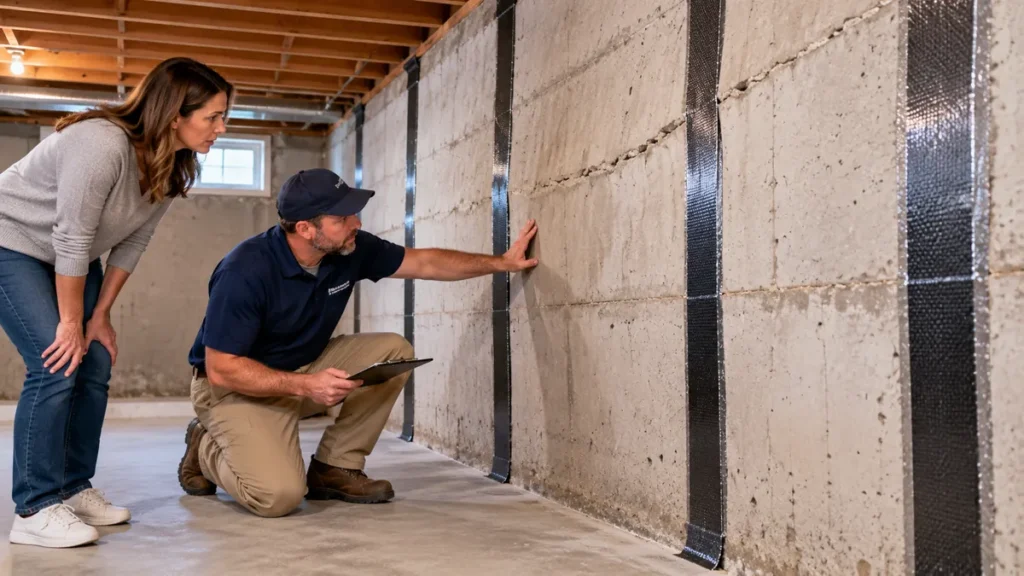
Short answer: Carbon fiber basement wall repair commonly costs about $350–$1,000 per installed strap in published 2026 planning ranges, while a small project may total roughly $800–$1,600 and a larger multi-wall project can cost several thousand dollars. These are budgeting ranges, not guaranteed quotes. The final price depends on movement, substrate condition, access, preparation, connections, crack and water work, and whether engineering or finish restoration is required.
Carbon fiber is usually a stabilization method. It can help limit additional inward movement in a suitable poured-concrete or masonry wall, but it generally does not push a badly bowed wall back into place, stop foundation settlement, or waterproof the basement by itself. A low-profile strap is not proof that the underlying cause has been diagnosed.
What carbon fiber reinforcement can—and cannot—do
Carbon-fiber fabric is bonded to the wall with structural epoxy. Depending on the system, it may also connect to the sill plate or floor framing and the footing. The intended result is normally to resist further movement and bridge or reinforce a crack path.
- It may be appropriate for: a wall stable enough for bonded reinforcement, limited bowing or cracking, and a defined stabilization objective.
- It is not automatically a cure for: active settlement, a severely displaced wall, failing footings, major block-wall deterioration, ongoing soil or drainage pressure, or a wall wet or unsound at the bonding surface.
- It does not automatically provide: waterproofing, crack sealing, structural engineering, fire resistance, or a straightened wall.
Rhino’s product FAQ says its carbon-fiber system reinforces a wall and prevents further inward movement; it does not return an already bowed wall to its original position or stop a sinking foundation. Read the manufacturer’s limitations. citeturn35search6
Why the wall must be assessed before anyone counts straps
A photograph or one level reading cannot determine the correct repair. The assessment should document wall material, crack direction and width, maximum displacement, whether movement is active, connections to the floor and framing, footing condition, water history, and exterior soil or drainage conditions.
Ask the evaluator to state the repair objective in writing: stabilize in its current position, seal a crack, reduce water entry, correct displacement, or address settlement. Those are different scopes. A contractor who promises that straps will straighten the wall is describing a different result from a contractor offering stabilization only.
Carbon fiber cost ranges for budgeting
The following figures are planning ranges assembled from published 2026 cost guidance and contractor-market examples. They are not a national price list. Labor rates, product systems, region, and scope can change the total substantially.
| Scope | Planning range | What can change it |
|---|---|---|
| One installed strap or wall section | $350–$1,000 | Access, preparation, connection details, local labor |
| Small one-wall repair | About $800–$1,600 | Number of straps, crack work, minimum service charge |
| Several straps on one wall | Often several thousand dollars | Wall height, spacing, finish removal, design requirements |
| Waterproofing, drainage, excavation, or structural correction | Separate quote | Not automatically included in carbon fiber pricing |
One 2026 market guide reports $350–$1,000 per installed strap and says the range assumes a wall suitable for reinforcement and excludes excavation or major structural correction. citeturn35search1 HomeGuide’s broader basement-wall guide reports a higher per-crack figure, which shows why “per crack,” “per strap,” and “per wall” prices must not be treated as interchangeable. See HomeGuide’s scope notes.
What a complete quote should include
Do not compare proposals by strap count alone. Request an itemized scope containing:
- Assessment, measurements, and any structural-engineer design or review.
- Product name, strap dimensions, quantity, spacing, and top/bottom connection details.
- Grinding or other surface preparation, coating removal, crack repair, and substrate repairs.
- Epoxy type, installation conditions, curing time, and protection during cure.
- Access, dust control, cleanup, permits or inspections when locally required.
- Water management, drainage, crack sealing, excavation, or sump work listed separately.
- Drywall, paneling, flooring, framing, painting, and finish restoration listed separately.
- Written warranty, exclusions, transfer terms, and who handles a warranty claim.
Published installation instructions commonly require grinding to a bare, sound surface, covering the crack completely, saturating the fiber with epoxy, and curing according to environmental conditions. One manufacturer instruction gives a 2–10 hour epoxy cure range depending on conditions. That is a product instruction—not a universal cure time for every system. citeturn35search36
Six homeowner problems that change the repair decision
The wall is already badly bowed
Carbon fiber may restrain additional movement but normally does not restore the original wall line. Ask for measured deflection and why bonded reinforcement is suitable. Significant displacement, unstable masonry, or continuing movement may call for anchors, braces, helical ties, partial reconstruction, or another engineered approach. Concrete Network notes that helical ties may be used with carbon fiber in moderate to severe movement. citeturn35search2
The basement leaks at the crack
Reinforcement is not waterproofing. Water may require crack injection, interior drainage, exterior excavation, grading and downspout work, or sump improvements. Get the water-control scope separately so a “dry basement” promise is not hidden inside a structural warranty.
The concrete is damp, painted, or deteriorated
Epoxy bonding depends on suitable preparation. Paint, loose concrete, dust, oil, caulk, and persistent dampness can interfere with adhesion. Ask who removes coatings, repairs unsound concrete, handles moisture, and decides whether the surface is ready.
The basement is finished
Drywall, insulation, framing, flooring, and stored belongings can make access expensive. State who removes and restores finishes, contains dust, and leaves the reinforcement observable after rebuilding.
The problem is settlement rather than lateral bowing
Diagonal or stepped cracks, sloping floors, sticking doors, or separation around openings may point to settlement that a strap does not address. Carbon fiber should not be sold as a substitute for underpinning, pier work, or a structural evaluation.
The sales explanation is stronger than the documentation
Be cautious when a bid gives a strap count without measurements, product identification, preparation details, or a written objective. Ask for photographs, a sketch, assumptions, exclusions, and a warranty describing the actual remedy.
Carbon fiber versus other repair approaches
| Approach | Usually aimed at | Important limitation |
|---|---|---|
| Carbon fiber | Low-profile stabilization of a suitable wall | Usually does not straighten severe bowing or stop settlement |
| Wall anchors or helical ties | Resisting lateral soil pressure; sometimes correction | May need exterior access, interior hardware, or engineering |
| Steel braces or beams | Support where greater restraint is needed | More visible; may affect usable basement space |
| Exterior waterproofing/drainage | Reducing water and soil pressure | Excavation and surface restoration may be substantial |
| Underpinning or pier work | Settlement or inadequate support | Different structural problem; not a strap replacement |
The right comparison is not “which material is strongest?” It is “which system is designed for this wall, movement, and desired outcome?” FEMA repair guidance emphasizes surface preparation, complete epoxy embedment, anchorage, and curing as inspection concerns for composite systems. citeturn35search39
Simple planning estimator
Use this only for early budgeting. It is not an engineering recommendation and does not select strap spacing.
Carbon fiber budget estimator
Planning range: $350–$1,000 before additional work.
Formula: number of installed straps or quoted wall sections × $350–$1,000, plus documented extras. The range is based on published 2026 market guidance, not a guaranteed local rate. Do not use it to decide how many straps are required. citeturn35search1
Before-hiring checklist
- Confirm local licensing, insurance, and permit requirements.
- Ask whether the company installs the named manufacturer’s system and follows its instructions.
- Request a written assessment, measurements, scope drawing, and itemized price.
- Verify responsibility for engineering, permits, preparation, cleanup, and finish restoration.
- Request references involving similar wall material and movement.
- Read contractor and manufacturer warranties separately, including exclusions for water, new movement, substrate failure, and unapproved alterations.
- Do not pay the full amount before the agreed work and documentation are complete.
Questions to ask before accepting a proposal
- What exact condition are you repairing, and how was it measured?
- Is the goal stabilization, crack sealing, correction, water control, or a combination?
- Why is carbon fiber suitable instead of anchors, braces, exterior work, or underpinning?
- What product, epoxy, spacing, and connection details are included?
- What surface preparation and moisture conditions are required?
- What is excluded if concealed damage is found?
- When can the wall be covered, painted, or framed?
- What does the warranty cover, and who services it?
Practical next steps
- Photograph cracks, water entry, finishes, and visible displacement with a date.
- Do not grind, drill, excavate, or remove supports before assessment.
- Get at least two written proposals based on the same information.
- Separate reinforcement, water control, engineering, access, and finish costs.
- Choose the clearest diagnosis and measurable objective—not automatically the lowest total.
- Keep product documents, photographs, warranty, measurements, and final inspection records.
Frequently Asked Questions
Will carbon fiber straps straighten a bowed wall?
Usually the stated purpose is to stabilize a suitable wall in its existing position. Ask for a separate written scope if correction is promised.
Does carbon fiber stop basement leaks?
No. Reinforcement and waterproofing are separate scopes.
How much does one carbon fiber strap cost?
Published 2026 planning guidance commonly places installed straps around $350–$1,000, but minimum charges, preparation, connections, and local labor can make a small project cost more.
Can carbon fiber repair foundation settlement?
It is not a substitute for diagnosing settlement. Piering, underpinning, or other structural work may be required.
Can straps be installed over paint?
Do not assume so. The surface generally must be sound, clean, and prepared under the selected system’s instructions.
How long before I can finish the basement wall?
Follow the product’s curing and inspection requirements and get written approval before covering the repair.
Are carbon fiber warranties transferable?
Not necessarily. Read the actual contractor and manufacturer warranty documents.
Should I get an engineer’s opinion?
Consider it when movement is significant, the cause is uncertain, settlement signs exist, or proposals recommend very different repairs.
Sources and further reading
HomeGuide: basement wall crack repair cost
Rhino Carbon Fiber: capabilities and limitations
Rhino Carbon Fiber: bowed-wall system details
Barricade/Dricore installation instructions
Concrete Network: bowed basement wall repair methods
FEMA 308: composite repair inspection considerations
For related water recovery, see our flooded-basement restoration guide and battery-backup sump-pump guide.
Keep reading
Related Articles
Interiors & Remodeling
Sill Plate Replacement Cost When Rot Is Found Under Exterior Walls
Interiors & Remodeling