
Home Systems & Energy
Dedicated Circuit Installation Cost for a Home Office
Compare dedicated circuit quotes for a home office, including equipment demand, outlet placement, wiring access, protection and finish repairs.

Home office dedicated circuit installation cost depends on what the circuit will serve and how the electrician can reach the room. A laptop setup may have different needs from a desk with several computers and a printer. If the office shares a circuit with demanding equipment elsewhere, have the electrician assess the existing arrangement before requesting a new one.
Published US estimates for a new dedicated circuit generally range from $250 to $900. [1] That is a broad reference, not a fixed price for every office. Distance from the panel, wiring access, outlet locations, required protective devices, and finish repairs can change the total. Start by defining which equipment the circuit will serve, then request an estimate for that specific design.
Home Office Dedicated Circuit Installation Cost: What the Quote Covers
Ask whether the dedicated circuit price includes an outlet or a particular equipment connection. Have the electrician state the wiring access and panel conditions assumed in the estimate.
| Office electrical project | Budget reference |
|---|---|
| New dedicated circuit | $250 to $900 published installed range |
| Additional outlets or difficult wiring route | Request separate scope and pricing |
| Panel or service changes | Separate assessment and estimate |
| Wall patching and painting | Confirm whether included |
Do not automatically multiply the circuit range by every outlet at the desk. A circuit and a receptacle are different parts of the design. Depending on the intended use, the electrician may propose one equipment specific circuit or an office circuit serving appropriate receptacles.
Have the quote describe that distinction. If you want a printer isolated from computer equipment, say so. If you want adequate convenient outlets across the office, explain that goal instead of assuming one new outlet provides the whole solution.
List the Equipment Before Requesting a Quote
Make an inventory of the devices you actually use. Include desktop computers, displays, docking stations, printers, network equipment, and lighting. Mention any equipment that operates intermittently but draws significant power when it starts or runs.
Provide manufacturer specifications or equipment labels when available. Tell the electrician what runs simultaneously and whether the office shares space with a workshop, exercise equipment, or another substantial load. Ordinary device count alone may not describe the demand well.
Keep future plans realistic. If a second workstation is likely, include it in the discussion. Ask for separately priced options so you can see what expansion adds. You do not need to purchase a large electrical renovation merely because the office might change someday.
Assess the Existing Circuit and the Cause of Problems
Tell the electrician which symptoms prompted the project. Does a breaker trip when a printer runs? Do lights elsewhere dim? Has an outlet become discolored? Those observations may indicate different issues, and a new circuit should not be used as a substitute for diagnosis.
ESFI identifies frequent breaker trips, unusual receptacle sounds, burning odors, and warm or discolored plates as warning signs requiring attention. It also explains that power strips add connection points rather than electrical capacity. [2]

Avoid repeatedly resetting a breaker or moving a concerning device from outlet to outlet to test it. Stop using affected equipment and request professional assessment. If there is smoke, fire, or an immediate danger, leave the area and call emergency services.
Wiring Access Often Explains the Price Difference
The distance from the panel is only part of the installation route. An accessible unfinished basement may allow a different approach from a finished room several floors away. Ask the electrician to explain the intended path and any openings it requires. For a different project where access also affects quotes, see our detached garage charging installation guide. Its equipment requirements do not apply to an office circuit.
Discuss surface mounted options where appropriate if you want to avoid extensive finish work. The electrician should explain how the proposed method fits the room and applicable requirements. Decide whether visible components suit your office before authorizing installation.
If concealed wiring requires wall or ceiling access, ask who restores it. A circuit quote may end with functional electrical work while excluding painting. That can be acceptable when the budget includes a clear restoration plan rather than an unexpected separate project.
Breaker Space and Protective Devices
Ask the electrician to assess the panel's suitability, including capacity and compatibility. An unused breaker space does not by itself prove that every proposed circuit can be added without further evaluation.
The quote should identify the protective devices required for the location and circuit under locally adopted rules. Ask the contractor to explain any AFCI or GFCI requirements that affect the price. Do not assume that a generic inexpensive breaker advertised online is suitable for your panel.
If panel work is recommended, request the reason and a separate estimate. A new office circuit does not automatically mean the entire service needs replacement. The proposal should connect the recommended change to an assessed condition or requirement. If a service upgrade is proposed, see our 100 amp to 200 amp upgrade cost guide for questions to ask about that separate scope.
Put Outlets Where the Office Needs Them
Show the electrician the desk position and how the room will be used. Think about furniture placement, cable routing, a printer station, and equipment that should remain accessible. Convenient locations can reduce reliance on temporary cords.
ESFI recommends professional assessment when heavy reliance on extension cords indicates that more outlets are needed. [2] Ask whether the plan addresses your permanent layout rather than simply installing a receptacle beside the easiest wiring route.
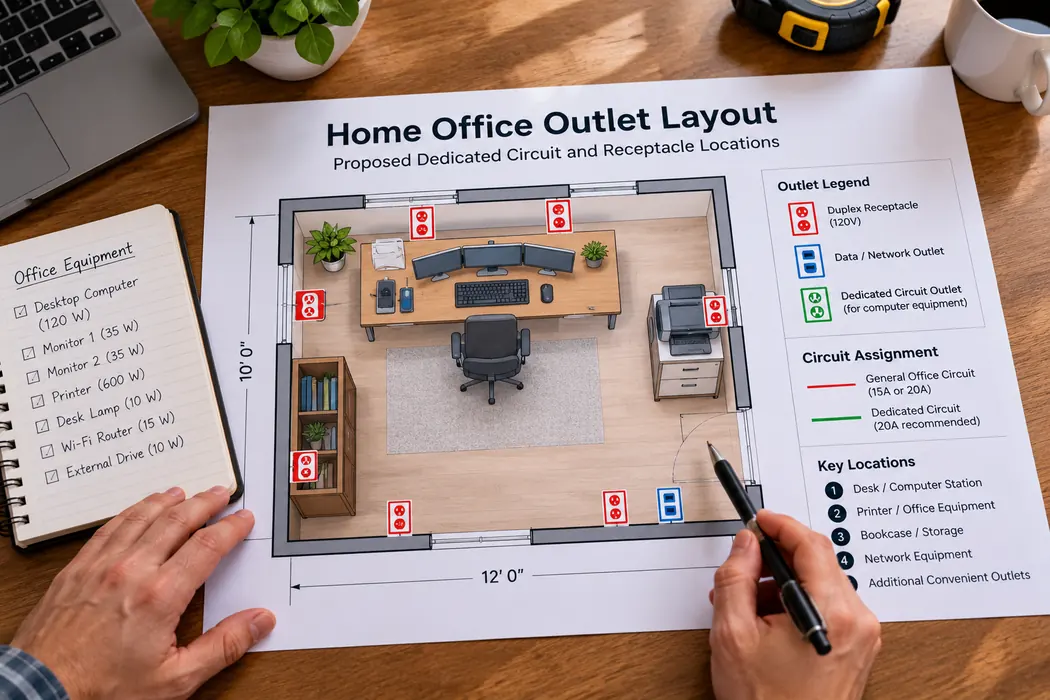
Consider moving the desk before work starts if that is already planned. A modest location change can affect routing or finish repair. Have the contractor revise the written scope instead of relying on an informal request during installation.
A New Circuit Does Not Provide Backup Power
Electrical capacity, surge protection, and outage backup solve different problems. If you need time to save work during an outage, ask about an appropriate UPS for the equipment. If you are concerned about surges, discuss suitable protection separately.
Do not add those products automatically to the circuit budget. Request an explanation of their purpose and separate prices. A UPS also has limits, so its runtime and supported equipment should match the need rather than a vague promise of uninterrupted operation.
Network cabling is another separate consideration. If you want wired internet at the desk, coordinate that request while access is being planned, but have it identified as its own scope. Electrical outlets alone do not improve an unreliable internet connection.
Compare Electrician Estimates for the Same Scope
Give bidders the same equipment list and office layout. Ask each to describe the circuit purpose, receptacle locations, wiring route, panel work, protective devices, permits, and finish restoration. A quote for a single nearby outlet is not comparable to a complete room layout.
Confirm who handles inspections and what documentation you will receive. Ask about the approval process if concealed conditions change the job. A clear change order is easier to evaluate than an unexplained final invoice.
Check relevant licensing and insurance. Ask when power to the affected areas may be interrupted so you can plan remote meetings and protect ongoing work. The proposal should make both the finished result and the temporary disruption understandable.
Completion Checks and Records
Have the electrician demonstrate the installed receptacles and explain which equipment the circuit is intended to serve. Request accurate panel labeling and any applicable inspection records. Keep the invoice with a simple office layout for future reference.
Report recurring trips, unusual sounds, or damaged devices promptly after the project. Do not assume that a new circuit makes every connected appliance suitable for use. The installation and the condition of the equipment both matter.
7 Practical Checks Before Accepting an Electrician Quote
1. Agree on the goal before pricing
Tell each electrician whether you are trying to solve a recurring problem, support a particular device, or make the room easier to use. If the office already works reliably but the outlets are awkwardly placed, describe that separately from any concern about available electrical capacity. A useful proposal should explain which part of the job addresses each goal.
Compare home office dedicated circuit installation cost only after bidders have assessed the same intended use. One quote might add a new circuit while another proposes changes to outlets on an existing circuit. Ask why the approaches differ and which observations support the recommendation. Have each bidder say what the proposal would leave unchanged.
2. Bring equipment specifications and a daily schedule
Make a short list of the equipment you expect to operate together. Separate the devices that are present every day from a printer or other device used occasionally. Include any planned replacement that materially changes the setup. Bring model numbers or manuals if a label does not clearly describe the product.
Ask what information the electrician still needs to estimate the office circuit. Do not copy the wattages from the illustration or assume that two similar-looking products have the same demand. If a contractor needs to inspect a device or its instructions, keep that item open until the model and intended use are confirmed.
3. Ask bidders to describe the complete wiring route
Identify the proposed outlet locations and show where furniture or built-in cabinets may limit access. Ask which surfaces may need openings, whether wiring will be visible, and which details cannot be confirmed before inspection. If the office is on a different floor from the panel, explain any finish work you have planned along the route.
The home office dedicated circuit installation cost should make clear what the electrician has priced for access and what belongs to a separate trade. Ask for a revised estimate when the route changes. Keep an alternative route separate so you can compare the difference in visible work, repair work and disruption.
4. Confirm what the panel assessment includes
Ask the electrician to explain any limits identified at the panel and why a proposed change is necessary. Have them identify the circuit purpose and what protective devices are included. If the estimate lists a panel or service change, request its own scope, price and reason so it can be assessed independently.
Do not treat a photo of unused breaker slots as a capacity assessment. Keep the home office dedicated circuit installation cost distinct from unrelated upgrades. If two proposals differ substantially, ask each contractor to explain the condition they observed and the work they consider necessary for this office installation.
5. Write down permits, inspections and approvals
Ask which office changes require a permit or inspection at your address and who will arrange them. Confirm whether the listed price includes fees and any return visits. If the work depends on permission from a landlord or building manager, resolve access and responsibility before scheduling the installation.
Ask the contractor to explain how an unexpected condition would be documented and priced. If a new opening or additional work is needed, request a written description and price before authorizing it. Keep changes alongside the home office dedicated circuit installation cost estimate rather than relying on a verbal total.
6. Plan for interruptions and finish restoration
Ask when electrical service to the affected areas may be interrupted and how much notice you will receive. Arrange a different workspace for calls or tasks that cannot be paused. If network equipment depends on an affected outlet, include that when discussing the timing with the electrician.
Confirm what the work area will look like at the end of the visit. An electrical quote may include cleanup but exclude drywall finishing and paint. Get those items priced separately where needed. A fair home office dedicated circuit installation cost comparison accounts for the same end condition in each bid.
7. Agree on the final walkthrough
Ask the electrician to identify which outlets belong to the new circuit and explain any limits on their intended use. Request a clear label and any applicable records. If both data and power outlets were added, confirm who completed each scope and who should receive a service request.
Compare the final home office dedicated circuit installation cost with the accepted estimate and any approved changes. Keep the invoice, circuit description and layout together. If problems recur, record the time, equipment in use, breaker behavior, and any unusual smell, warmth, sound, or discoloration. That record gives the electrician useful information without asking you to troubleshoot energized wiring.
Budgeting for Home Office Dedicated Circuit Installation Cost
Start with the quoted home office dedicated circuit installation cost and check whether taxes and required fees are already in the written total. Record any extra charges separately so you can compare quotes on the same basis. A blank line indicates a question to resolve, not a free service.
If one electrician includes finish repairs and another excludes them, get a separate price for those repairs before comparing totals. Ask whether the work includes a return visit to finish the installation after another trade has completed its part.
Keep the home office dedicated circuit installation cost separate from an optional UPS, network cabling or future workstation. If you choose an optional item, ask who supplies it and whether the proposed installation includes any setup. This avoids comparing one firm’s basic electrical work with another firm’s larger office upgrade package.
For a room being renovated, ask when the electrician needs access relative to drywall, paint and furniture installation. If another trade must return after the circuit is installed, record that in the schedule and budget. Agree on who will coordinate the handoff before the room is closed up or made unavailable.
Home Office Dedicated Circuit Installation Cost: Compare the Finished Room
Consider two electricians who propose the same outlet locations. One includes access from an unfinished room and leaves a small opening for someone else to patch. The other includes an alternate route and coordinates the repair. Ask each to identify the exact surfaces affected and whether the office can be used between visits.
When comparing home office dedicated circuit installation cost, include any separate return visit, finish repair, or permit fee required to complete the same scope. If an item cannot be priced yet, ask what inspection or decision will resolve it. A quote that lists the same number of outlets can still have a different total once all responsibilities are clear.
Keep a marked layout with the final home office dedicated circuit installation cost estimate. Ask the electrician to confirm any changes from the layout before work starts, especially if a desk, printer station or cabinet has moved.
How to Decide Whether Your Home Office Needs a Dedicated Circuit
A dedicated circuit is not automatically necessary for every desk. The stronger reason to request one is a combination of symptoms and demand: repeated trips, warm or discolored receptacles, an office that shares power with a workshop or heating appliance, or equipment that the existing circuit cannot reliably support. A quiet laptop-and-monitor setup may need less electrical work than a desktop workstation, laser printer, networking rack, and powered speakers operating together.
Do not treat “dedicated” as a magic label. Ask the electrician to identify the existing circuit, what else is connected to it, the proposed office receptacles, and the equipment the new circuit is intended to serve. If the real problem is a loose connection, damaged receptacle, overloaded shared circuit, or failing appliance, adding another circuit alone may leave the hazard unresolved.
Office Load Planning: Count Equipment, Not Just Outlets
Before requesting a quote, make a simple load list. Record the model or nameplate information for the computer, monitors, printer, docking station, UPS, network equipment, task lighting, and any equipment that may be added later. Note which devices run together and which are occasional. A printer may be idle most of the day but still matter when it operates; a space heater or other heat-producing appliance can change the risk and should not be casually grouped with sensitive office electronics.
Share the list with the electrician, but do not use internet wattage tables as a substitute for the manufacturer label or professional assessment. The contractor should determine whether the proposed circuit, breaker, wiring, receptacles, and protective devices match the actual installation and locally adopted electrical rules. A good estimate explains the design assumptions instead of simply promising a higher amp rating.
What a Dedicated Office Circuit Quote Should Include
Two quotes are not comparable unless they describe the same finished result. Ask each bidder to separate the following items:
| Quote item | What to confirm |
|---|---|
| Electrical design | Which equipment and receptacles the circuit is intended to serve |
| Panel work | Breaker type, available capacity, compatibility, labeling, and any proposed upgrade |
| Wiring route | Panel-to-office path, visible or concealed sections, access openings, and cable length assumptions |
| Receptacles | Number, locations, grounding, and required AFCI/GFCI or other protection under local rules |
| Permit and inspection | Who applies, who pays, and whether a return visit is included |
| Finish restoration | Drywall patching, paint, cleanup, and responsibility for work by another trade |
Published national planning references vary. HomeGuide reports about $250–$900 for a new dedicated circuit, while Angi’s 2026 guide reports a broader $570–$1,000 range for many projects and notes that inspection, difficult access, or panel work can add cost. These are market references, not a guaranteed quote for your home. Local labor, route difficulty, permit fees, and existing conditions should control the estimate.
Why Panel Condition Can Change the Project
An open breaker position does not prove that the panel is suitable for the proposed circuit. The electrician may find an incompatible panel, inadequate capacity, damaged components, obsolete equipment, crowded wiring, or a service limitation. Those conditions should be explained in writing. Request a separate price for a panel or service change so you can distinguish required work from optional improvements.
Be cautious if a contractor recommends a larger breaker simply because the current breaker trips. A higher-rated breaker is not a safe cure for wiring that was not designed for it. The U.S. Consumer Product Safety Commission advises homeowners not to replace a fuse or breaker with a higher-amp device to stop trips; the cause should be evaluated by a qualified electrician. CPSC wiring-hazard guidance supports this safety approach.
AFCI, GFCI, Grounding, and Local Code: What Homeowners Should Ask
Protection requirements depend on the room, receptacle location, circuit design, and the electrical code adopted by your state or local authority. Many living-area circuits require arc-fault protection under current code provisions, while ground-fault protection is associated with locations where water or damp conditions create shock risk. A basement office, garage office, or office near a sink may not be treated like a dry room on an upper floor.
Ask the electrician to name the protective device included in the quote and explain why it applies. AFCI and GFCI serve different purposes: AFCI protection responds to hazardous arcing, while GFCI protection is intended to reduce shock risk from ground faults. ESFI recommends qualified installation and regular testing of these protective devices. Do not buy a generic breaker online and assume it will fit or protect your panel correctly.
Permit and inspection rules are local. Some jurisdictions require a permit for a new branch circuit; others have different rules for minor electrical work or owner-occupied homes. Verify with the local building department or have the licensed electrician confirm the requirement before work begins. The article’s cost ranges cannot predict your municipality’s fee or approval process.
When a Power Strip, Surge Protector, or UPS Is Not the Answer
A power strip gives you more plug positions, not more circuit capacity. The CPSC warns that overloaded cords and power strips can create a fire hazard, and ESFI lists warm outlets, flickering or dimming lights, burning odors, and frequent trips as warning signs that deserve attention. Use temporary extension cords only as directed by their listing and rating; do not hide them under rugs, run them through walls, or use them as permanent office wiring.
A surge protector and a UPS solve different problems from a new branch circuit. Surge protection addresses certain transient voltage events, while a UPS can provide limited backup time for selected equipment during an outage. Neither one repairs an overloaded circuit, damaged receptacle, poor grounding, or an unsuitable panel. Price these as separate decisions and match a UPS to the equipment load and the time you actually need to save work or shut down safely.
Warning Signs That Should Stop the Project From Being Treated as Routine
Pause normal office use and seek professional help if a receptacle or faceplate is hot, smells burned, makes unusual sounds, shows discoloration, sparks, gives a shock or tingle, or repeatedly trips. CPSC guidance identifies hot receptacles and switches as potential fire hazards. Do not keep resetting the breaker, install a larger breaker, open the panel, or test a suspected fault by moving the device from outlet to outlet.
If there is smoke, active sparking, or fire, leave the area and call emergency services. If a breaker trips only when a particular appliance operates, unplug that appliance and tell the electrician exactly what happened. The goal is diagnosis first; the new office circuit should not become a way to ignore a defective computer, printer, cord, or receptacle.
Illustrative Budget Example: Compare the Same Finished Scope
Illustrative example—not a quote: Suppose an upstairs office needs one new circuit, several receptacles, an AFCI-compatible protective device if required locally, a long concealed route from the panel, a permit, and limited drywall repair. A nearby office above an unfinished basement may fall near the lower end of published planning ranges, while the upstairs installation with difficult access may cost more even if both projects have the same number of outlets. The difference is the route, labor time, finish work, and local requirements—not necessarily the receptacle count alone.
When comparing bids, ask each contractor to price the same route assumption, number of receptacles, protection, permit responsibility, inspection, cleanup, and restoration. If the route cannot be confirmed until an inspection, ask for a clearly described allowance and the trigger for a change order. This makes the budget useful without pretending that a national average is a promise.
Before-Hiring Checklist for a Home Office Electrician
- Confirm the contractor’s license or registration requirements for your jurisdiction.
- Ask for proof of liability insurance and workers’ compensation where applicable.
- Request a written scope identifying the circuit purpose, outlet locations, route, protection, panel work, permit, inspection, and finish repairs.
- Ask whether the electrician or homeowner contacts the permitting office and who pays the fee.
- Confirm the expected outage window and how the office equipment should be protected during the work.
- Ask how concealed damage or an unsuitable panel will be documented before extra work is performed.
- Get warranty terms for workmanship and identify which manufacturer warranties apply only to the equipment.
- Keep the final invoice, panel label information, inspection record, and marked outlet layout.
Frequently Asked Questions
Does Every Home Office Need a Dedicated Circuit?
No. A modest setup may be adequately served by an appropriate existing circuit. Ask an electrician to assess the equipment, shared loads, and circuit condition before deciding on additional work.
Can One New Circuit Serve Several Office Outlets?
That depends on the design and intended loads. Have the quote specify the arrangement. The word dedicated should not leave you guessing whether the proposal serves one device or the office area.
Will a Bigger Power Strip Solve Breaker Trips?
No. It does not increase the available circuit capacity. Have the cause investigated rather than adding more connection points. A useful office upgrade addresses the assessed load and the way you use the room.
How Much Does a Dedicated Circuit Cost for a Home Office?
Published planning ranges are roughly $250–$900 from HomeGuide and $570–$1,000 in Angi’s 2026 guide, but your electrician’s written scope matters more than a national average. Long routes, permits, difficult access, protective devices, panel work, and drywall repair can change the total.
Can I Add a Dedicated Circuit to an Old Electrical Panel?
Possibly, but the panel must be assessed for compatibility, capacity, condition, and locally required protection. An unused breaker space alone is not enough evidence. Ask for the assessment and a separate price if a panel change is recommended.
Does a Home Office Circuit Need AFCI Protection?
It may, depending on the room, circuit, adopted code, and local enforcement. Ask the electrician to identify the required protective device and include a compatible product in the written quote. Requirements are not identical in every jurisdiction.
Can a Dedicated Circuit Stop My Computer From Losing Power?
It can reduce problems caused by an overloaded shared circuit, but it cannot prevent utility outages, a failing computer power supply, or every voltage disturbance. A properly selected UPS is a separate backup-power decision.
Is a Surge Protector the Same as a Dedicated Circuit?
No. A surge protector and a dedicated circuit address different concerns. A surge protector does not increase circuit capacity or repair unsafe wiring. Ask an electrician to diagnose trips, heat, odors, or discoloration before adding equipment.
Who Pulls the Electrical Permit?
That depends on local rules and the project arrangement. Ask the electrician or building department before scheduling work, and confirm whether the quote includes the application fee, inspection, and any return visit.
Should I Install the Circuit Myself to Save Money?
Electrical panel and branch-circuit work can create shock, fire, code, and insurance risks. This guide is for planning and quote comparison, not installation instructions. Use a qualified electrician who can assess the panel, route, protection, grounding, and inspection requirements.
Sources
- HomeGuide: Dedicated circuit installation cost — consumer-reported planning ranges.
- Angi: Dedicated circuit cost guide — 2026 planning ranges and cost factors.
- U.S. Consumer Product Safety Commission: Guide to Home Wiring Hazards — breaker, hot-receptacle, and qualified-electrician safety guidance.
- U.S. Consumer Product Safety Commission: Extension Cords and Power Strips — overload and temporary-cord safety.
- Electrical Safety Foundation International: Home Electrical Safety — overload signs, AFCI/GFCI information, and testing reminders.
- Electrical Safety Foundation International: AFCI overview — arc-fault protection basics and professional-installation guidance.
Sources checked November 13, 2026. Pricing is a planning reference and can change by location, labor market, route, permit, panel condition, and finish work. This guide does not provide circuit-sizing or installation instructions.
Keep reading
Related Articles

Home Systems & Energy
Sewer Camera Inspection Cost Before Buying an Older House
Home Systems & Energy